
Cabin Crew Compensation: Explained
The union’s response to WestJet’s Cabin Crew Compensation Explained. We’re bringing the real-world pairing data and true hourly wages they didn't show you.
Detailed Analysis:
Official Narratives vs. Operational Reality
-
WestJet's Explanation: (source)
WestJet cabin crew are paid using a credit-hour system, the standard compensation model used by many North American airlines. Credit hours compensate cabin crew for both flight and non-flight duties through a single rate of pay, rather than paying separately for each hour on duty. This system includes minimum monthly guarantees, overtime thresholds, and contractual pay protections.
Detailed Reality:
It is true that many North American airlines use a credit-hour model. However, the fact that a compensation system is common does not mean it is fair or beyond scrutiny.
Many airline compensation systems were developed decades ago for an industry that looked very different from today's operation. Cabin crew responsibilities have expanded significantly, including increased security requirements, regulatory compliance, customer service expectations, and operational responsibilities.
The central issue in bargaining is not whether a credit-hour system exists. The issue is whether compensation adequately reflects the full scope of work performed and the amount of time cabin crew are required to be on duty.
The union believes that evaluating compensation solely through the lens of credited flight time fails to capture the reality of modern cabin crew work.
-
WestJet's Explanation: (source)
A credit hour (equal to one flight time hour) is a unit of pay used in the airline industry to compensate cabin crew for a full range of duties, not just time spent in the air. Rather than paying a lower hourly wage for every hour on duty, the credit hour system combines flight time, ground duties, delays, and other required work into a single, higher rate of pay. That rate is then “credited” across the full duty day.
Detailed Reality:
Credit hours are an industry pay mechanism, but they are not the same as an hourly wage.
Under this system, compensation is primarily tied to credited flight time rather than the total number of hours a cabin crew member is required to be at work. While WestJet states that the credit rate is intended to compensate for flight duties, pre-flight duties, post-flight duties, delays, and other work requirements, the result is that multiple hours of work are often grouped together under a smaller number of payable credit hours.
For example, it is common for a cabin crew member to spend significantly more time on duty than the number of credit hours they ultimately receive. Check-in requirements, aircraft preparation, boarding, deplaning, security duties, and time spent managing operational delays all form part of the workday, but they do not generate compensation on a one-for-one hourly basis.
The issue is not whether cabin crew receive a paycheque. The issue is transparency. A stated credit rate may appear competitive, but it does not reflect a cabin crew member's effective rate of pay when all duty time is considered.
That is why we believe the more meaningful measure is not the credit-hour rate itself, but the relationship between total duty hours worked and total compensation received.
-
WestJet's Explanation: (source)
No. The credit hour system provides wages on a basis other than duty time worked. Credit hours are calculated and paid as outlined in the collective agreement. All duty time—on the ground and in the air—is compensated according to the collective agreement. WestJet’s pay system includes minimum guarantees and additional protections that increase compensation when duty days run longer than planned.
Detailed Reality:
The answer depends on how we define compensation.
WestJet is correct that cabin crew receive pay according to the formula negotiated in the collective agreement. However, that does not mean every hour spent working generates direct compensation on an hour-for-hour basis.
Cabin crew begin working long before an aircraft leaves the gate. Safety checks, equipment verification, crew briefings, boarding responsibilities, passenger management, security procedures, and compliance obligations are all required parts of the job.
During these periods, cabin crew are fully responsible for the safety and operation of the cabin and are subject to the same professional expectations and liabilities that apply during flight. Yet much of this time is absorbed into the credit-hour system rather than compensated through a transparent hourly wage structure.
The question is not whether cabin crew receive a paycheque. The question is whether the compensation system fully reflects all of the time and responsibility required to perform the job.
From the union's perspective, significant portions of required work are effectively averaged into a compensation model that places greater value on flight time than on many of the duties performed before departure, during delays, and after arrival.
-
WestJet's Explanation: (source)
Yes. Pre-flight and post-flight duties are compensated through the credit-hour system. Credit-hour rates are designed to account for responsibilities performed before departure, during operations, and after arrival, not just time spent in the air. Additional protections may apply during extended delays or duty periods.
Detailed Reality:
Pre-flight and post-flight duties are included within the credit-hour compensation model, but they are not compensated separately on an hour-for-hour basis.
Cabin crew regularly perform safety checks, security inspections, emergency equipment verification, crew briefings, boarding procedures, passenger assistance, and post-arrival duties before any block time begins.
These responsibilities are mandatory, safety-critical functions of the job. Yet they do not generate pay in the same way that a traditional hourly wage would compensate time worked.
The union's concern is not whether pre-flight and post-flight work exists within the compensation model. It is whether these duties are appropriately recognized and valued given their importance and the time required to complete them.
-
WestJet's Explanation: (source)
When a day includes delays or extra time away from home, the collective agreement provides protections (extended duty premiums and RIGs) that may increase compensation. These provisions ensure cabin crew are not compensated based on flight time alone during irregular operations.
Detailed Reality:
Extended duty premiums and RIGs are important contractual protections, but they are often misunderstood as direct compensation for every additional hour worked. They are not.
RIGs are formulas used to determine the minimum credit a cabin crew member will receive for a pairing or duty period. Depending on the circumstances, that minimum credit may be based on factors such as:
A minimum credit per duty period.
Duty time divided by a prescribed ratio.
Time away from base divided by a prescribed ratio.
A combination of these calculations.
These protections establish a minimum pay floor, but they do not necessarily create a one-to-one relationship between additional duty time and additional compensation.
For example, a pairing originally scheduled for eight hours of duty with four hours of flight credit may experience delays that extend the duty day to twelve hours. Even though the crew remains at work for four additional hours, the applicable RIG calculation may only increase the payable credit to six hours. The result is that duty time can increase significantly while compensation increases only marginally.
This is why the union's concern is not whether protections exist—it is whether those protections fully recognize the time cabin crew are required to remain on duty and available for work.
WestJet also references extended duty premiums as a protection during irregular operations. These premiums begin only after a crew member exceeds the maximum schedulable duty period and are paid as separate contractual amounts. While they provide important recognition of exceptionally long duty days, they are not incorporated into the cabin crew member's hourly wage and do not compensate all additional duty hours worked prior to the premium threshold being reached.
In practical terms, a crew member can spend several additional hours at work due to delays, gate holds, operational issues, or passenger disruptions without receiving equivalent additional pay for that time. The existence of RIGs and extended duty premiums does not change the underlying reality that compensation remains primarily tied to credit hours rather than total duty hours.
-
WestJet's Explanation: (source)
Full-time crew are guaranteed 80 hours/month; part-time 50 hours/month. Includes minimum 12 days off for full-time; 16 for part-time. One credit hour accounts for approx 1.5 duty hours. Cabin crew working 1,440 duty hours per year would receive 960 credit hours per year. For comparison, a full-time employee on a standard work schedule works approx 2,080 hours a year.
Detailed Reality:
WestJet's comparison to a standard 2,080-hour work year overlooks a fundamental difference between cabin crew work and most traditional occupations: time away from home.
Cabin crew do not simply report to work and return home at the end of each shift. Many pairings require employees to remain away from their home base for multiple days at a time, during which they must remain fit for duty, comply with rest requirements, and be available to operate assigned flights.
While not all of this time is considered active duty, it nevertheless represents time in which employees are unable to fully participate in their normal personal, family, and community lives.
The reality of airline work also includes irregular schedules, overnight pairings, weekend and holiday assignments, time-zone changes, sleep disruption, and operational unpredictability. These factors place unique demands on cabin crew that are not reflected in a simple comparison of annual hours worked.
The value of guaranteed days off cannot be separated from the realities of the profession. Those periods are not simply leisure time; they are an essential part of recovering from extended periods away from home and maintaining fitness for duty.
Comparing cabin crew compensation to a traditional office schedule risks overlooking the unique lifestyle sacrifices that are inherent to commercial aviation.
-
WestJet's Explanation: (source)
WestJet reports that cabin crew earn between $28.45 and $53.61 per credit hour, while widebody cabin managers earn between $37.54 and $69.69 per credit hour. WestJet notes that these rates are subject to ongoing collective bargaining discussions and states that it remains committed to meaningful wage improvements.
Detailed Reality:
The rates shown above are credit-hour rates, not effective hourly wages.
Because cabin crew are compensated through a credit-hour system rather than a duty-hour system, the advertised rate does not necessarily reflect what a crew member earns for each hour they are required to work.
The effective hourly value of a credit hour depends on the relationship between credited time and total duty time. As duty hours increase relative to credited hours, the actual hourly value of compensation decreases.
This distinction is critical because members do not experience compensation as a credit-hour calculation—they experience it as time spent at work, away from home, and responsible for the safety and well-being of passengers.
For this reason, the union believes compensation should be evaluated based on real-world operating conditions rather than advertised credit-hour rates alone.
The Flight Credit System: TCRD vs. TDUTY
The credit system relies on masking uncredited work hours within total trip windows. By auditing the direct relationship between Total Duty (TDUTY)—which accounts for check-in time before flights, ground time, and check-out windows—against your actual Total Credit Paid (TCRD), we expose exactly how a flight attendant's professional hour is systemically diluted.
These profiles track realized operations where multi-leg days, sits between flights, and actual ground duties actively consumed unpaid crew availability.
Pairing Example: May 14-17, 2026
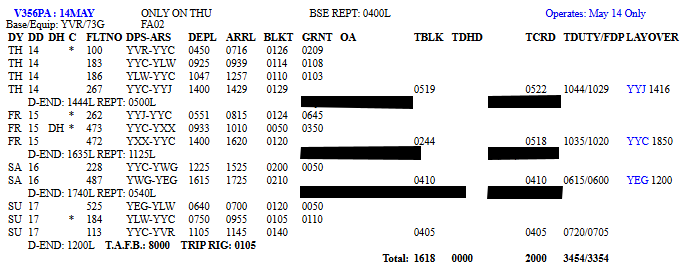
Below Federal Minimum Wage
The bottom scale true wage of $16.53/hr falls $1.62 below the Canadian federal minimum wage benchmark of $18.15/hr.
Pairing Example: May 19-22, 2026
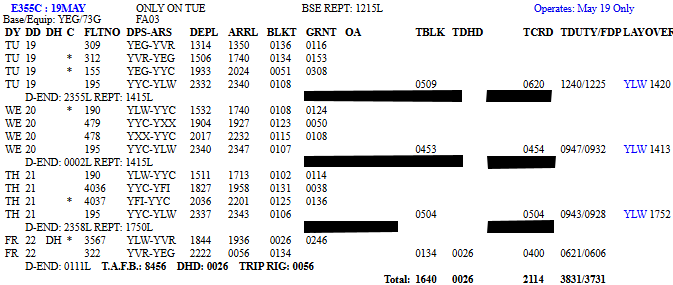
Below Federal Minimum Wage
The bottom scale true wage of $15.92/hr falls $2.23 below the Canadian federal minimum wage benchmark of $18.15/hr.
Pairing Example: May 14-16, 2026
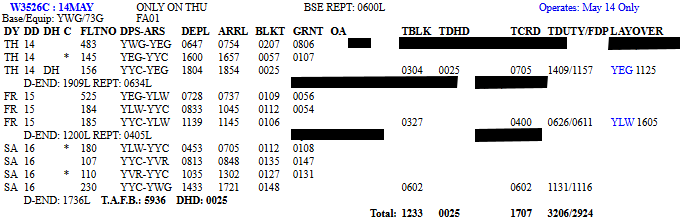
Below Federal Minimum Wage
The bottom scale true wage of $15.40/hr falls $2.75 below the Canadian federal minimum wage benchmark of $18.15/hr.
Pairing Example: May 16-20, 2026
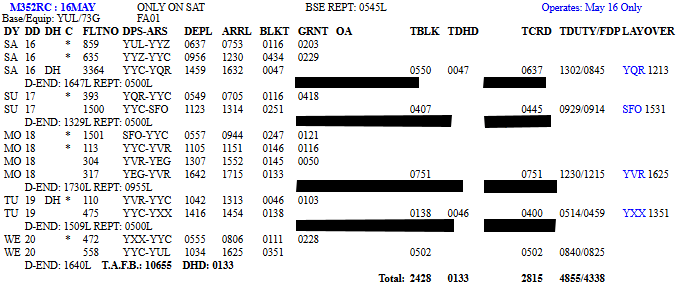
Below Federal Minimum Wage
The bottom scale true wage of $16.68/hr falls $1.47 below the Canadian federal minimum wage benchmark of $18.15/hr.
These summaries reflect pairings scheduled for June—proving that baseline hourly devaluation is built directly into upcoming trip awards before ever pushing back from the gate.
Pairing Example: June 15-19, 2026
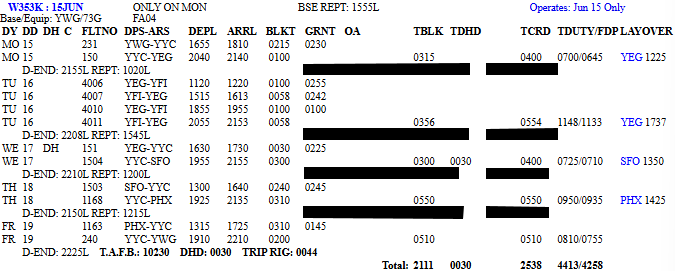
Below Federal Minimum Wage
The bottom scale true wage of $16.74/hr falls $1.41 below the Canadian federal minimum wage benchmark of $18.15/hr.
Pairing Example: June 30-July 4, 2026
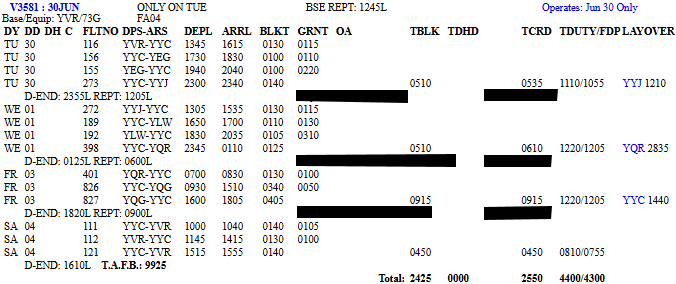
Below Federal Minimum Wage
The bottom scale true wage of $16.95/hr falls $1.20 below the Canadian federal minimum wage benchmark of $18.15/hr.
Pairing Example: June 23-27, 2026
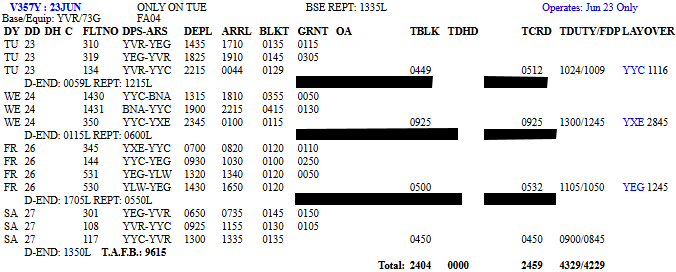
Below Federal Minimum Wage
The bottom scale true wage of $16.59/hr falls $1.56 below the Canadian federal minimum wage benchmark of $18.15/hr.
Pairing Example: June 3-7, 2026
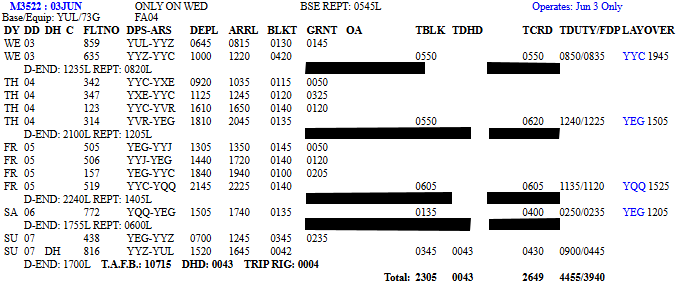
Below Federal Minimum Wage
The bottom scale true wage of $17.25/hr falls $0.90 below the Canadian federal minimum wage benchmark of $18.15/hr.
Dynamic Calculator
Enter your pairing information below to map how uncredited work windows impact your true hourly rate.
Enter Flica Pairing Details
Dynamic Calculation
Federal Minimum Wage Benchmark: $18.15 / hr
Awaiting Input
Please enter your pairing details above.
Below Federal Minimum Wage
The calculation profile true wage of $0.00/hr falls $0.00 below the Canadian federal minimum wage benchmark of $18.15/hr.
Marginally Over Minimum Wage
The true wage of $0.00/hr technically stays above the line, but sits within a razor-thin margin of the $18.15/hr benchmark.
How we compare across all major Canadian carriers





Footnotes
Some carriers have pay increases every 6 months - namely Air Canada and Flair. The steps with an asterisk (*) have a pay increase before it. Since at WestJet we gain a step once per year, we have included the equivalent pay rate.
Porter is currently negotiating their first Unionized agreement. The pay rates listed are from their current non-unionized contract.
Porter currently has 20 steps on their pay scale (topping out after 20 years) with a top out of $57.59. Flair currently has 14 steps on their pay scale (topping out after 13 years) with a top out of $55.88.
Air Canada wages listed are Mainline, not Rouge.
Sources:
Transat Collective Agreement (2022-2026) - Not publicly available
CUPE Porter Contract (01 Apr 25) - Not publicly available