
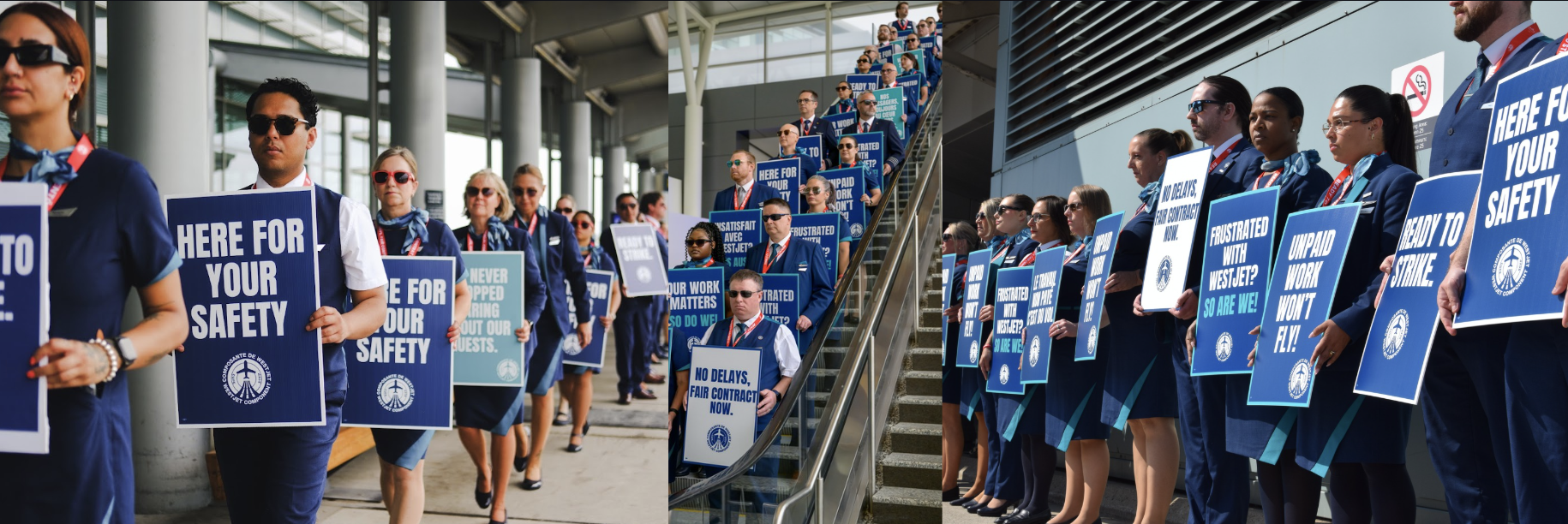
WestJet Mainline Job Action/Strike HQ
Strike Status:
REACHED A TENTATIVE AGREEMENT
Quick Links & Forms
-
Job Action FAQ
-
Return to Work Protocol
-
Stranded Members Form
-
Strike Pay Form
-
National Strike Pay Regulations
-
MESC Operate/DH Form
-
MESC Hotel Form
-
Strike Handbook (QRH)
-
Operational Wind-Down Agreement
The WestJet Mainline Bargaining Committee issued a Notice of Dispute on April 27, 2026. Conciliation began on May 13, 2026, and concluded on July 11, 2026, followed by the federally mandated cooling-off period and mediation process.
On July 30, 2026, CUPE Local 8125 issued a 72-hour strike notice to WestJet, and WestJet subsequently issued a corresponding lockout notice. Throughout this period, the parties remained engaged in negotiations in an effort to reach a negotiated settlement.
As of 4:15 a.m. MT on August 3, 2026, the WestJet Mainline Bargaining Committee and the Company reached a Tentative Agreement.
The Tentative Agreement will now be prepared for presentation to the membership. Members will have an opportunity to review the details of the proposed agreement, attend information sessions, and participate in a ratification vote.
The Bargaining Committee believes it is important that members take the time to carefully review the complete agreement package before voting. Information regarding ratification timelines, voting procedures, and supporting materials will be communicated through official Union channels as soon as they become available.
The best agreement is one that reflects the priorities and voices of the membership. The FAQ below has been updated to provide information regarding the ratification process and will continue to be revised as additional details become available.
Further updates will be provided as preparations for ratification continue. The Bargaining Committee remains committed to ensuring members have the information they need to make an informed decision on the Tentative Agreement.
Do you have a question about the strike?
This contact form will be directed to our Member Engagement and Strike Committee. Please read below for more information regarding, if you have further questions, please submit the form above. Note: The Local will communicate more details as they become available.
Please use the form above for job action questions. Should you have unrelated day-to-day issues, please speak with your Base VP: wjcomponent.ca/contact.
Latest “In the Jumpseat” Podcast:
Frequently Asked Questions
These are split into three categories:
General, Employment Specific and Strike Pay.
Last Updated: August 3, 2026
GENERAL FAQ
-
The final phases of the collective bargaining process in Canada may lead to Job Action should the Union and the Company not be able to reach a deal at the table.
For the Union, this would be a strike or work stoppage.
For the Company, this would be a lock out.
Under the Canada Labour Code, neither party can pursue a Strike/Lock Out until 60 days of Conciliation are complete, a 21-day Cooling Off Period and 72 hours notice is given indicating that Job Action will occur.
-
A Notice of Dispute under the Canada Labour Code is the official notification sent to the Minister of Labour indicating that bargaining has failed to produce a Collective Agreement.
The Notice of Dispute initiates federal conciliation procedures, marking a formal impasse, and is required before a legal strike or lockout can occur.
-
Conciliation is a process used when the Union and the Employer are unable to reach an agreement during bargaining.
The Minister will then appoint conciliation officers, who will meet with both parties and help facilitate discussions in an effort to reach a Collective Agreement.
Note: Conciliation is NOT Arbitration. Arbitration is where a third party makes a binding decision on outcomes. During Conciliation we still negotiate with the Company.
-
Mediation is a process where a neutral third party helps the Union and the Employer continue discussions and work toward reaching a Collective Agreement.
Unlike Conciliation, which is a formal step in the bargaining process under the Canada Labour Code, Mediation is a voluntary process focused on helping the parties find common ground and resolve outstanding issues.
Note: Mediation is not Arbitration. The mediator cannot impose a settlement or make decisions for either party. Any agreement must be reached voluntarily by both the Union and the Company.
-
This question is no longer applicable at this time.
A strike began on August 2, 2026 at 12:01am MT. As of 4:15 a.m. MT on August 3, 2026, the Bargaining Committee and the Company reached a Tentative Agreement. The current focus is the ratification process.
-
A strike vote allows members to decide whether to provide the Union with a strike mandate. A strong strike mandate demonstrates to the Employer that members are united and prepared to take job action, if necessary, to achieve a fair collective agreement.
On July 15, 2026, WestJet Cabin Personnel represented by CUPE provided the Bargaining Committee with an overwhelmingly positive strike mandate with 99.4% of the membership voting in favour.
Under the Canada Labour Code, a strike vote mandate is valid for 60 days from the date the vote is held.
The strike mandate provided the Union with the authority to pursue job action if necessary. The strong member mandate demonstrated solidarity throughout bargaining and supported efforts that ultimately resulted in a Tentative Agreement being reached on August 3, 2026.
-
WestJet flight attendants are currently bargaining for improvements across several key issues, with wages, unpaid work, and scheduling among the most pressing.
Many WestJet flight attendants remain among the lowest paid in the industry, with some earning less than minimum wage when all hours worked are taken into account.
On average, flight attendants also perform up to 35 hours of unpaid work each month, and we are calling for an end to this practice so that every hour worked is fully compensated at their hourly wage.
In addition, we are seeking stronger and safer scheduling protections, including improved minimum rest periods, which can currently be as low as 9 hours.
These priorities reflect a broader goal: to ensure WestJet Cabin Personnel are fairly compensated, properly protected, and fully respected for the essential work they do every day.
-
A Tentative Agreement has been reached, and therefore no strike is currently underway.
The next step is ratification, where members will have the opportunity to review the complete agreement package and vote on whether to accept the proposed Collective Agreement.
-
Striking when negotiations break down, is our greatest power as workers. A strong presence on the picket line sends a clear message to the Employer that the bargaining team has strong support from the members. As the saying goes, “the longer the line, the shorter the strike.”
When the employer sees that we are united and strong, they are more likely to concede to our demands at the table.
-
You have a legal right to strike.
Management cannot discipline members for supporting their union. CUPE will support you if any action is taken by your employer, security or the police.
Follow direction from your Union via official communications prior to engaging in any job action.
Members should not engage in any form of job action without explicit instructions from their Union.
-
As of 4:15 a.m. MT on August 3, 2026, the Bargaining Committee and the Company reached a Tentative Agreement.
The parties have therefore reached a negotiated settlement and members will now proceed to the ratification process. Additional details regarding the Tentative Agreement, member information sessions, and voting procedures will be communicated through official Union channels.
-
A Tentative Agreement is a proposed Collective Agreement reached between the Union and the Company through collective bargaining.
A Tentative Agreement does not become the new Collective Agreement until it has been reviewed and approved by the membership through a ratification vote.
Members will receive details of the proposed agreement, have an opportunity to ask questions, and vote before any changes take effect.
EMPLOYMENT SPECIFIC FAQ
-
If you are on a Vacation day during a strike, you can come to a picket line and will be eligible to earn Strike pay.
For specific questions around the reconciliation of Vacation time and pay, members must reach out to their DPM.
-
As legal strike action is underway, Cabin Crew who were operating flights at the commencement of the strike are covered by the Operational Wind Down Agreement. While you are away from base, you will not be left without support or direction.
Under the Operational Wind Down Agreement, Cabin Crew who are operating a flight when job action begins will complete that flight to its scheduled destination. Members who are mid-pairing may also be required to operate or deadhead additional flights solely for the purpose of safely winding down operations and returning aircraft, guests, and crew to Canadian airports.
If the Company is unable to immediately return you to your base, you will either:
Be provided hotel accommodation in your last destination city for up to seven (7) days, or until the labour dispute ends, whichever occurs first; or
Be provided Company-arranged transportation to another Canadian city, subject to seat availability.
The applicable provisions of the Collective Agreement, including compensation and scheduling, will continue to apply while members are participating in the operational wind-down process. Members who remain in hotel accommodation under the agreement will continue to receive their contractual per diems for up to seven (7) days, or until the labour dispute concludes, whichever occurs first.
Union representatives will remain available throughout any labour dispute to answer questions and assist members who are away from base. Members are encouraged to review the Wind Down Agreement and ensure they are prepared for potential operational disruptions.
For a detailed breakdown of possible scenarios, please refer to the Wind Down Agreement flowchart.
Click here for the signed Wind Down Agreement - which has been uploaded to the CCD as well.
-
Training is considered Bargaining Unit work and therefore, if members are scheduled to be in training during an active strike, they should report to a picket line and would be eligible for strike pay.
Rescheduling of training would occur post strike.
-
Probationary employees are able to participate in all Union sanctioned activities, including a strike.
The Company cannot discipline or terminate members for participating in lawful activities of the Union.
-
If you are on any ad hoc assignment during a strike, do not report to work.
Sign up for a picket shift on the Job Action Website.
-
WestJet Cabin Personnel are currently on strike. Do not perform modified duties and do not enter WestJet property to perform work unless specifically directed by the Union.
It is important to note that being ineligible for strike pay does not automatically prevent a member from participating in strike activities. Members receiving STD/LTD, Workers Compensation or EI benefits may participate in picketing or other approved strike duties, provided that doing so does not conflict with their medical restrictions, benefit conditions, or any other limitations associated with their leave.
If you are receiving disability benefits, Workers' Compensation benefits, or Employment Insurance benefits, we strongly encourage you to review any proposed strike activities with your benefits provider before participating. Members should ensure that any participation remains within their approved restrictions and does not jeopardize their eligibility for ongoing benefits. The Union will work to accommodate members wherever reasonably possible but cannot determine or guarantee how a third-party benefits provider may assess an individual's participation.
-
Members who are already on an approved STD or LTD claim before labour action begins will continue to receive disability benefits in accordance with the terms of the insurance policy, including applicable maternity leave top-up provisions.
WestJet Cabin Personnel are currently on strike. Members on approved disability or leave programs should review the guidance below.
It is important to note that being ineligible for strike pay does not automatically prevent a member from participating in strike activities. Members receiving STD/LTD, Workers Compensation or EI benefits may participate in picketing or other approved strike duties, provided that doing so does not conflict with their medical restrictions, benefit conditions, or any other limitations associated with their leave.
If you are receiving disability benefits, Workers' Compensation benefits, or Employment Insurance benefits, we strongly encourage you to review any proposed strike activities with your benefits provider before participating. Members should ensure that any participation remains within their approved restrictions and does not jeopardize their eligibility for ongoing benefits. The Union will work to accommodate members wherever reasonably possible but cannot determine or guarantee how a third-party benefits provider may assess an individual's participation.
-
During the current strike, your health benefits will continue without interruption. CUPE National will pay the employer and employee benefit premiums, ensuring coverage remains in place throughout any legal job action.
This includes:
Extended health coverage and prescriptions
Dental coverage
Vision care
Paramedical services
Mental health supports and EFAP (where applicable)
Group life insurance
Other insured benefits under the current plan
Members should continue using their benefits as usual. There is no need to postpone appointments, prescriptions, or claims due to the possibility of job action.
-
As of August 1, 2026, the Company has advised that travel privileges are suspended for Cabin Personnel for the duration of the labour action.
This includes travel privileges for employees, companions, dependents, parents, and any other eligible travellers. The company has also stated that interline travel will not be available and that future-dated bookings may be cancelled. Members should ensure they review any upcoming travel plans accordingly.
-
We have confirmed that there will be picket lines in all permanent bases and the following domiciles
Comox (YQQ)
Nanaimo (YCD)
Victoria (YYJ)
Abbotsford (YXX)
Kelowna (YLW)
Saskatoon (YXE)
London, ON (YXU)
Kitchener-Waterloo (YKF)
Hamilton (YHM)
Ottawa (YOW)
Quebec City (YQB)
Halifax (YHZ)
For details on Strike Pay see FAQ on strike pay below.
Note: the Operational Wind Down Agreement has language that may assist commuters in getting back to their domicile if they are on a pairing at the commencement of job action.
The Company will attempt to return the Cabin Personnel to their base on a Company-operated flight, either by assigning them to operate a return flight or by deadheading them back to base.
If the Company is unable to return the Cabin Personnel to their base on a Company-operated flight, the Cabin Personnel may choose one of two options: (1) remain in the Last Destination City with Company-provided hotel accommodations for up to seven (7) days, or until the Labour Action ends if earlier; or (2), travel on a Company-operated flight to another Canadian city served by WestJet, subject to seat availability.
This second option recognizes that, if the Company may not be able to return a Cabin Personnel directly to their base, they may prefer to travel to their domicile or to another Canadian city from which they can make their own arrangements to return home.
-
If you are away from Base during a strike, you can participate in picket activities in another Base. Picket lines have been confirmed in the following cities:
Comox (YQQ)
Nanaimo (YCD)
Victoria (YYJ)
Abbotsford (YXX)
Kelowna (YLW)
Saskatoon (YXE)
London, ON (YXU)
Kitchener-Waterloo (YKF)
Hamilton (YHM)
Ottawa (YOW)
Quebec City (YQB)
Halifax (YHZ)
For details on Strike Pay see FAQ on strike pay below.
-
During a strike, your MMG will likely be adjusted based on the number of credit hours missed during Labour Action.
As crew pay is complex, members should reach out to the Crew Credit department following labour action to understand the reconciliation of hours. If there is a discrepancy members are encouraged to reach out to their Base VP.
-
As some airport authorities require members to scan their RAIC to enter employee parking areas, members are encouraged to take transit, rideshare, or be dropped off for their pairing to avoid having to rely on accessing Company parking where possible.
Each airport authority will handle employee parking differently.
If you are parked in an employee lot and return to base during a strike attempt to retrieve your vehicle and if there are issues, contact the Local airport authority for assistance.
-
The Operational Wind Down agreement is designed to ensure the safe return of all crew. In the event that there is an unexpected situation where someone would be in a hotel after job action begins, the Union will communicate directly with them and work with the Company to have that person returned home.
-
As per the Operational Wind Down Agreement, members will continue to be paid as per the expired Collective Agreement until they are returned to base or 1(a), (b), or (c) have been actioned of the agreement.
STRIKE PAY FAQ
-
When on Strike you will not receive compensation from WestJet for any days of work missed.
Strike pay is meant to ensure that members have some form of compensation during a strike to support financial obligations.
-
The CUPE National Strike Fund and the Airline Division's Supplementary Strike Fund.
CUPE National puts aside 5% of any per capita tax (Union Dues) for strike benefits and campaigns to avert strikes.
-
Short Answer: $100 / day up to a maximum of $500 / week and $2000 per month when completing picketing activities.
This $100 / day is made up of two separate funds:
CUPE National Strike Fund: $70 / day.
CUPE Airline Division’s Supplementary Strike Fund: $30 / day.
A typical strike schedule is 20 hours per week (5 days × 4 hours).
National Strike fund provisions:
Week 1-5 of the strike, maximum strike pay is $350 for a minimum of 20 hours of picketing or completing other assigned duties.
Week 6-11 of the strike, strike pay is increased to $375 per week, for a minimum of 20 hours of picketing or completing other assigned duties.
Week 12 - 15 of the strike, strike pay is increased to $400 per week, for a minimum of 20 hours of picketing or completing other assigned duties.
Week 16+ of the strike, strike pay is increased to $450 per week, for a minimum of 20 hours of picketing or completing other assigned duties.
Information in the Airline Division’s Supplementary Strike Fund:
The Division Defence Fund shall pay benefits of $30.00 per day, up to a maximum of $150.00 per week, in addition to the CUPE Strike Fund entitlement for the first six months of a work stoppage.
In the event of a work stoppage progressing beyond six months, the Council of Presidents has the discretion to increase its contributions to striking or locked out members by up to $50.00 per week.
Benefits will be paid in the case of a strike or lockout recognized by the CUPE National Strike Fund Regulations for the duration of the work stoppage or until Division funds are depleted.
-
A member who is entitled to strike benefits under Strike Fund Regulations shall receive strike pay beginning on the first day of the strike, so long as they complete their required duties.
Members will receive an email with specific instructions on required steps for receiving strike pay including submitting banking information and checking in and out of picket lines to record shift times.
-
To be eligible for strike benefits, a member must fulfill the following requirements:
be in good standing, according to the CUPE Constitution, before a strike begins. For the purpose of this provision, a Rand Formula (Union dues) payee who makes regular contributions to the Strike Fund is considered to be a member in good standing;
been on the active payroll of the employer who is subject to the strike action at the beginning of the strike; and,
participate in the strike by performing assigned strike duties for at least 20 hours per calendar week. However, when deemed appropriate by the Strike Benefits Committee, and when approved by the National Secretary-Treasurer, schedule and hours of picketing can be designed differently to reflect the workplace and/or accommodate a member or group of members.
-
We do not have a confirmed payment timeline at this time, as CUPE 8125 has not yet received the strike pay funds from CUPE National.
In the meantime, we have already begun the process of reviewing and verifying participation records to help expedite payments once the funds are received. CUPE requires that every strike pay claim be supported by appropriate check-in and check-out records, either through digital time stamps or approved manual documentation.
As part of this verification process, we are reviewing attendance records and reconciling any missing or inconsistent entries. If there is an issue with your check-in/check-out records or additional information is required, a member of our team may contact you directly to assist in resolving the discrepancy.
We appreciate your patience as we work through this process. Our goal is to ensure that all eligible members are paid accurately and in accordance with CUPE's requirements. We will provide an update as soon as we have more information regarding payment timelines.