

WestJet Bargaining Blog
In addition to emails sent directly to you, our dedicated bargaining blog serves as a secondary source for all official communications related to the ongoing negotiations. Here you find:
Regular updates: Following bargaining sessions, we post summaries of the discussions and progress made.
Important announcements: Keep an eye out for crucial announcements regarding timelines, membership surveys, and upcoming meetings.
Information documents: Key documents related to the bargaining process, such as proposals and updates, are posted here.
Bargaining Blog: Stay Up-to-Date
Mainline Bargaining Update #1: First Day at the Table
Dear Members,
Your Bargaining Committee is pleased to report that our first day of bargaining with the Company was a strong success. We began by exchanging opening statements, including a powerful message delivered by our President, Alia Hussain.
CLICK HERE TO READ THE OPENING STATEMENT READ BY ALIA HUSSAIN
From the outset, we made it clear that change is essential and must come now, as our members — the employees of WestJet — are struggling and deserve meaningful improvements in this round of negotiations.
Both parties also agreed on several important protocol items, including a commitment to maintain respect and professionalism throughout the bargaining process. Work is underway to finalize additional dates in November, December, and January to keep negotiations moving forward.
To help keep members informed, we have launched our Negotiations Tracker, available at wjcomponent.ca/negotiation-tracker.
This resource will:
Show which articles are in progress and which have been agreed to in principle.
Be updated as often as possible (generally at the end of a bargaining week), though not always in real time during critical stages of bargaining.
Reflect that any items agreed to in principle may still be adjusted by either the Union or the Company until the full agreement is complete.
Be used as a means to understand the progress being made at the table.
On the first day, the following articles were tabled:
By your Union Committee:
Article 1 (Preamble)
Article 5 (Discrimination and Harassment)
Article 13 (Union Communications)
By the Company:
Article 51 (Printing of the Agreement)
Article 8 (Amendments to the Agreement)
Article 30 (Grievance Procedure)
It is standard practice that negotiations begin with non-monetary issues before moving on to monetary matters. This ensures that language can be agreed to on other articles prior to starting negotiations on bigger articles with financial aspects.
It is important to remember that the negotiated language in all articles carries importance as they all impact our working conditions.
We will continue to provide updates regularly, and it is important that members carefully read email communications to stay informed. Bargaining is a marathon, not a sprint. The continued support, and determination of the Membership will give the Bargaining Committee your collective strength at the Bargaining Table.
Together, we are moving forward with strength and determination to achieve the change our members deserve.
In Unity,
WestJet Bargaining Committee
Alia Hussain - President
Bryan Hansraj - WestJet Unit VP
Jean-Francois Laframboise - YVR/YEG Rep
Shane Campbell - YYC Rep
Justin Patterson - YYZ Rep
Cailey Millard - YWG/YUL Rep
Alex Grigoriev - Local Executive (Alternate)
Cameron Jones - Local Executive (Alternate)
Bargaining Learning Series: Step 2 – Notice to Bargain
Dear Members,
As of yesterday, September 16th, your WestJet Mainline Bargaining Committee has officially served WestJet with our Notice to Bargain. This is an exciting and pivotal step in the bargaining process!
You will notice that our email headers have changed from Yellow (Preparations Stage) to Green (Active Negotiations stage). Depending on the nature of the communication during the Bargaining Process you will see the colours change indicating the nature of the communication to keep you informed.
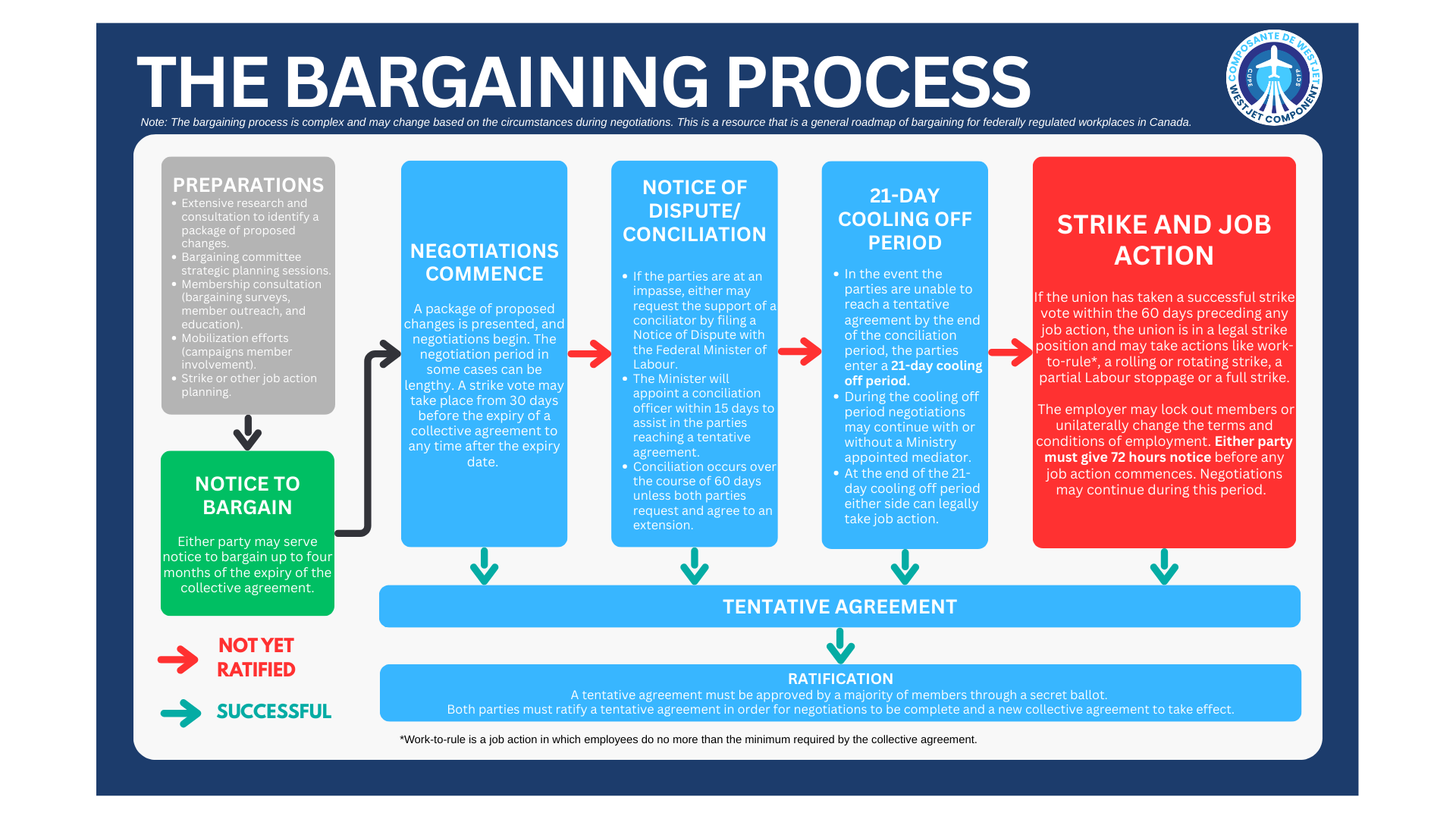
What Does “Notice to Bargain” Mean?
When the Collective Agreement is approaching expiry, the first legal step is called the “Notice to Bargain”. This is when the Union or the Company can serve Notice which formally starts the negotiations process as per the Canada Labour Code. This timeline is outlined in Section 52 of our Collective Agreement.
When does Notice to Bargain get served?
Up to 120 days before the agreement expires, either the Union or the Employer can formally serve notice.
The Union served the Company Notice to Bargain on September 16th immediately following the conclusion of our Town Halls in all Permanent Bases.
When will the Union first meet with the Company?
Once notice is served, both sides are legally required to meet within 20 days and bargain in good faith under the Canada Labour Code. This means honest discussions and genuine efforts to reach a deal.
Our first meeting with the Company will occur on September 22nd with multiple dates agreed to in September and October so far.
Why does it matter?
This is the first step in the bargaining process as governed by the Canada Labour Code. It starts the entire process that leads to either a tentative agreement, mediation or job action.
The Union committed to negotiating in good faith as ultimately the best contracts are reached at the bargaining table.
What order are items negotiated in?
Proposals are discussed in sequence, starting with non-monetary language before moving into monetary items.
Monetary proposals are anything that has a cost associated with them (ex. Per diems, vacation days, and wages).
How long will bargaining take to get a new contract?
The duration of bargaining varies depending on the number of proposals, how complex they are, and the availability of both sides to meet. It’s important to note it is not uncommon for bargaining to continue past the expiry of a collective agreement. The current agreement remains in force until either a tentative deal is reached, or the parties reach an impasse and move to the next legal steps.
Does Our Current Agreement Still Apply After Notice to Bargain?
Yes. All wages, benefits, scheduling rules, compensation, and protections in our current Collective Agreement remain in effect until a new agreement is reached or we enter job action (a strike or lockout). This is because of the “statutory freeze” under the Canada Labour Code, Section 50(1), which states:
“Where notice to bargain collectively has been given, the employer shall not, except with the consent of the trade union, alter the rates of wages or any other term or condition of employment of the employees in the bargaining unit.”
The statutory freeze lasts until: A new agreement is ratified by members; or the Union and Company reach the end of the legal bargaining process and job action (strike/lockout) is possible.
This protection ensures the Company cannot pressure workers by making sudden changes while bargaining is underway.
Visit our Mainline Bargaining for the latest updates as we begin our negotiations for CA2! Next week we will also be launching a Negotiations Tracker so you can see the progress being made towards reaching a tentative agreement.
In Unity,
WestJet Bargaining Committee
Alia Hussain - President
Bryan Hansraj - WestJet Unit VP
Jean-Francois Laframboise - YVR/YEG Rep
Shane Campbell - YYC Rep
Justin Patterson - YYZ Rep
Cailey Millard - YWG/YUL Rep
Alex Grigoriev - Local Executive (Alternate)
Cameron Jones - Local Executive (Alternate)
Don’t Miss Out: Bargaining Town Halls Start Next Week
Dear Members,
We are at a pivotal moment in our collective bargaining journey and your participation has never been more important! The upcoming Bargaining Priorities Town Halls are not just another meeting.
Bargaining is not something that happens to you — it happens with you. The proposals we’ve built are rooted in the feedback you provided through the bargaining survey, and now is the time to see the results and understand the direction we are taking to the table. Your engagement and presence give your Bargaining Committee the strength and mandate we need to fight for what matters most.
Registration & Attendance Details
Pre-registration is strongly encouraged so we can reserve enough space for everyone. Please register here: wjcomponent.ca/bargaining-townhalls
Registration will also be available at the door, but pre-registration helps us plan accurately.
If you’re attending while on duty, uniforms are welcome. Otherwise, regular clothes appropriate for work (business casual) are acceptable.
Why attend in person?
See how your input shaped the bargaining proposals
Hear directly from your Bargaining Committee about strategy and priorities
Ask questions in a safe, closed-door environment where you can speak freely
Stand with fellow members and demonstrate our collective power
Why closed meetings?
In bargaining, strategy is everything. To protect our collective interests, there will be no recording or streaming permitted. Information that reaches the Company prematurely could weaken our position at the table. This closed format not only safeguards our strategy it ensures that you can speak freely without concern that your comments will leave the room.
Can’t attend?
We know not everyone can join due to scheduling constraints. A high-level summary of the discussions will be shared afterward. However, the full context, strategy, and discussion only happen in person.
Town Hall Schedule:
September 9 – Edmonton
September 10 – Vancouver
September 11 – Calgary
September 13 – Montreal
September 14 – Toronto
September 15 – Winnipeg
Pre-register now at wjcomponent.ca/bargaining-townhalls
Your input shaped our proposals. Your participation now ensures we go to the table united, informed, and strong. Let’s fill these rooms and show the Company that this membership is engaged and ready.
In Unity,
WestJet Bargaining Committee
Alia Hussain - President
Bryan Hansraj - WestJet Unit VP
Jean-Francois Laframboise - YVR/YEG Rep
Shane Campbell - YYC Rep
Justin Patterson - YYZ Rep
Cailey Millard - YWG/YUL Rep
Alex Grigoriev - Local Executive (Alternate)
Cameron Jones - Local Executive (Alternate)
CUPE’s No-Concessions Policy at the Bargaining Table
Dear Members,
As we prepare for upcoming rounds of bargaining, we want to reaffirm an important principle that guides our work: there will be no concessions in our negotiations.
CLICK HERE TO READ THE FULL POLICY ON OUR BARGAINING WEBSITE
A concession occurs when a union accepts an employer’s demand for something less than what members already have—whether that’s wages, benefits, or working conditions or any other current contract provision —without receiving something of equal or greater value, or importance, in return. Concessions move us backwards, and CUPE’s National Executive Board has a clear policy that we will not bargain them.
A two-tier provision is always a form of concession. It happens when different groups of employees doing the same work receive different wages, benefits, or working conditions—based on their date of hire. For example, new hires might be offered lower pay, fewer benefits, or weaker pension protections than existing employees. While it may seem like it doesn’t affect current members directly, two-tier systems divide the membership, weaken solidarity, and create long-term downward pressure on everyone’s working conditions. For these reasons, CUPE’s policy is clear: we will not negotiate two-tier agreements.
We must acknowledge that our former Sunwing cabin personnel were ordered by the Canada Industrial Relations Board (CIRB) to remain on the Sunwing collective agreement pay scale. This situation will be brought forward at the bargaining table with the goal of ensuring that all WestJet cabin personnel are on the same wage scale and compensation structure. Importantly, as part of CUPE’s no-concessions policy, it is not the position of the union to negotiate lower total compensation for any group of members. Our bargaining mandate is to raise standards and unify compensation, not to reduce it.
We also want to acknowledge our history as a component. When our first collective agreement was reached, there was no prior CUPE contract in place. While many members felt that agreement contained concessions, technically it was not considered concessionary bargaining, since there was no existing collective agreement to diminish. At that time, we were transitioning from an employee association to a certified union, which is a very different starting point than where we are today.
Now, we are in a stronger position. We have a collective agreement that establishes our rights, protections, and working conditions—and CUPE’s policy ensures that this agreement is the floor, not the ceiling. Bargaining is about moving forward, not backward.
We have already informed the Company of CUPE’s no-concessions and no-two-tier position so they are fully aware of our stance at the bargaining table. Our focus is on improving wages, benefits, and working conditions for all members, not giving them up.
This strong and united position protects not only current members, but also future generations of WestJet cabin crew. If a provision is not good enough for us, it is not good enough for those who will come after us.
We will continue to keep you updated as bargaining progresses. Together, with solidarity and determination, we will ensure that our next agreement builds on what we have—not less.
In Unity,
WestJet Bargaining Committee
Alia Hussain - President
Bryan Hansraj - WestJet Unit VP
Jean-Francois Laframboise - YVR/YEG Rep
Shane Campbell - YYC Rep
Justin Patterson - YYZ Rep
Cailey Millard - YWG/YUL Rep
Alex Grigoriev - Local Executive (Alternate)
Cameron Jones - Local Executive (Alternate)
CA1 Unpacked - Volume 1 (Duty RIGs and How Pairing Credit Is Calculated )
RIGs (or Ratio in Guarantee) exist in the world of aviation scheduling to ensure compensation for crew members, especially when their actual flight time is low compared to the time they spend on duty or away from base.
HISTORY:
Prior to the ratification of CA1, WestJet Cabin Personnel’s schedules were based solely on block hours. Deadheads were paid at 50% as they are today, but only to the Cabin Personnel originally scheduled the deadhead.
Adapting duty period minimums, including deadhead value to daily reconciliation, as well as a variety of RIGs have had a tremendous value added to our scheduling world. With that being said, they’re still commonly misunderstood and we hope to change that for us all.
The following information can be found in Article 41-5, Pairing Reconciliation, but let’s explore the terms we use every day when looking at our schedules.
DEFINITIONS: (found in Article 2 of the Collective Agreement)
Duty Period: The total time in a daily period the Cabin Personnel is at work, calculated from the report time to the release time.
Block Hours: The value of the operated flights, scheduled and calculated by the out-event to the in-event of each flight segment.
Credit Hours: The unit of time that Cabin Personnel earns for pay and scheduling purposes includes the multitude of factors that we’re going to cover.
MDPC: The Minimum Duty Period Credit, which is 4 hours.
Here is the current CA language that we will expand on and explain in greater detail, with examples.
41-5 PAIRING RECONCILIATION
41-5.01 A Cabin Personnel will be credited the greater of their originally scheduled Credit Hours of the entire pairing or the Credit Hours actually operated by the Cabin Personnel over the entire pairing. Any increase in pairing Credit pursuant to this provision will be considered monthly scheduling period credit growth.
41-5.02 The original scheduled Credit Hours of the pairing is calculated as the combined total Credit Hours of all the scheduled duty periods in the pairing or one (1) Credit Hour for each four (4) hours of scheduled time away from base (TAFB) in the pairing (“Trip RIG”), whichever is greater.
The original scheduled Credit Hours of each individual duty period will be the greater of:
a) The scheduled Block Hours, plus any Deadhead Credit, in the duty period,
b) The minimum duty period credit (“MDPC”) of four (4) Credit Hours, or;
c) Fifty percent (50%) of the scheduled duty time in the duty period (“Duty RIG”)
41-5.03 The actual operated Credit Hours of the pairing is calculated as the combined total Credit Hours of all the operated duty periods in the pairing or one (1) Credit Hour for each four (4) hours of actual TAFB in the pairing (“Trip RIG”), whichever is greater.
The actual operated Credit Hours of each individual duty period will be the greater of:
a) The actual Block Hours, plus any Deadhead Credit, completed in the duty period,
b) The MDPC of four (4) Credit Hours, or;
c) Fifty percent (50%) of the actual duty time completed in the duty period (“Duty RIG”)
COMMON MISCONCEPTION
Q- “The block time and credit hours of my pairing are the same. Where’s the RIG?”
A - This is a common misconception that all pairings have a RIG or minimum attached to them. What’s important to remember is that the credit hours of a duty period or a pairing will always be the GREATER OF any of these calculations.
IMPORTANT NOTE: Only a “TRIP RIG” will be reflected on Flica specifically, while the MDPC and Duty Rig will not. This information is included in the Final Bid Packages released by the Company for bidding purposes, covered at the end of this document.
MINIMUM DUTY PERIOD CREDIT vs MINIMUM DAILY CREDIT: These are two very distinct concepts; we do not currently have a minimum daily credit, but instead use a minimum duty period credit, meaning that the minimum credit value is only associated with duty periods within a particular pairing. A red-eye duty period as an example might cover two different days, but is reconciled as only one duty period.
DEEPER DIVE
Below we will list real world examples using actual pairings and see where these improvements have and will continue to benefit us.
EXAMPLE ONE:

This pairing has several examples that highlight the application of the topics discussed above, and highlight the benefits to Cabin Personnel:
Day 1: DH YYC – YQR: This daily duty period is now reconciled at the duty period minimum of 4 hours because even though the deadhead was credited at 50% of the flight time, the greater of the 2 possible calculations is the 4-hour MDPC (minimum duty period credit).
Day 2: YQR – YYC / YYC – YYT: In this case, no RIG or minimums are credited as the value of the flying is the greatest possible value.
Day 3: DH YYT – YYZ / YYZ - YHZ: This one is a little harder to catch! The operated leg was only worth 2:10 and the deadhead was credited at 2:20, so why is the day worth 4:35? The duty period for the day is 9:10, and when you divide that by 2 for the “Duty Rig” of 50% of the duty day, it works out to 4:35!
Day 4: YHZ – YYC: No RIGs or minimums as the flying block time is the greatest value
Summary: Looking at the TBLK (Total Block) for the entire pairing, the value is 14:46. Without any RIGs or minimums in the agreement (aka how it used to be), that would be the value of this pairing. However, when we look at the TCRD (Total Credit) value of 21:11, it has summarized the duty period credit values and provided the Cabin Personnel 6:25 worth of credit value they wouldn’t have had before!
EXAMPLE TWO:

This 4-day pairing (with only 3 duty periods) provides some more examples and explanations!
Day 1: YYC –LAX: Because the value of the flight operated falls below the Minimum Duty Period Credit of 4 hours, the value of that day is increased to 4:00.
Days 2 and 4 both exceed the MDPC value of 4 hours.
Summary: When added together, the daily credit values of all the duty periods only total 13:10. So why is this pairing worth 17:55? The TRIP RIG now becomes the greatest possible pairing reconciliation value, as the TAFB/4 ratio equating to 17:55.
Again, using only TBLK (Total Block) times, this pairing would have 5:23 less value towards the value of the pairing.
EXAMPLE THREE:

Lastly, we’ll look at this one-day turn. In this case, there are no minimums or RIGs applied as the value of the flying is the highest possible pairing and duty period value.
As mentioned at the beginning, RIGs and daily minimums are vital to protecting the value of a crew member’s time by ensuring proper credit values are associated with all our pairings. This doesn’t mean that every pairing or duty period has a RIG attached to them! However, RIGs and daily minimums ensure that appropriate value is attached to each pairing and duty period, enhancing our schedules and time at work.
CARRY OVER PAIRINGS
Another common source of confusion is how credit is applied to carry over pairings, specifically when a TRIP rig is present on a specific pairing.

The example above has several important things to take note of. This is a 4-day pairing with only 3 duty periods, with an extended layover in YQR. But most importantly, there is a TRIP rig applied to the entire pairing, as the TAFB/4 calculation yields the highest possible value as it’s more than the sum of the 3 duty periods.
However, this pairing also started in July and finishes in August. For bidding and trading purposes, only the credit values for the duty periods in the preceding month count towards in this case July’s schedules. All remaining credit values, including the TRIP RIG are applied to the following month, in this case August. In this example, 4:00 would be applied to the Cabin Personnel’s July schedule, with the remaining 10:27 applied to August.
BIDDING:
Lastly, to review how these values apply to each pairing, an important graphic is included with each bid package each month.

On here, several important values are highlighted specifically with the purple circles and lines.
Duty periods with a ‘L’ indicate that no RIG or minimum is applied
Duty periods with a ‘M’ indicate that the MDPC is applied
Duty periods with a ‘R’ indicate the Duty Rig is applied
And finally,
A ‘T’ is shown next to the Credit Time value of a pairing if the Trip Rig is applied to the whole pairing, and if it doesn’t a ‘D’ would be placed next to the Credit Time value.
Note: This communication is in English as the language in the Collective Agreement is negotiated in English and applied in English (Article 51-2). If you have questions about the content within, please reach out to your base representative and we will connect you to a French speaking Union representative to provide any clarification and support on these topics. We are committed to and will continue to provide bargaining updates in both official languages.
In Unity,
WestJet Bargaining Committee
Alia Hussain - President
Bryan Hansraj - WestJet Unit VP
Jean-Francois Laframboise - YVR/YEG Rep
Shane Campbell - YYC Rep
Justin Patterson - YYZ Rep
Cailey Millard - YWG/YUL Rep
Alex Grigoriev - Local Executive (Alternate)
Cameron Jones - Local Executive (Alternate)
WestJet Bargaining Committee Update – Building Momentum Together
Dear Members,
Your WestJet Mainline Bargaining Committee has been actively engaged in planning, research, and consultation as we prepare for the upcoming round of bargaining. Our recent meetings have focused on reviewing member feedback, analyzing the current Collective Agreement (CA), consulting with industry experts, and developing tools to better inform and engage you—our membership.
Below is our update on the key areas of focus this past month:
CA1 Unpacked – Building a Baseline Together
One of the most consistent pieces of feedback we received from member surveys and member interactions was that many Cabin Personnel find the current collective agreement (CA1) difficult to navigate or fully understand. This challenge is even more pronounced among new hires and those who joined through the Swoop or Sunwing integrations. With that in mind, your Bargaining Committee is launching CA1 Unpacked—a quick-reference learning series designed to give all members a stronger foundation before we head into CA2.
Each edition of CA1 Unpacked will focus on one section or concept within the current collective agreement, broken down into plain language, with real-life examples of how it applies to your work. These will be sent out every two weeks and archived on our website so that members can access them at any time. When timely or urgent topics arise, we’ll release additional editions to ensure members are equipped with clear, accessible information.
This initiative is part of our broader strategic plan to ensure every member has a shared baseline understanding of their rights and entitlements under CA1—so that when it comes time to consider CA2, we’re all able to participate with confidence and clarity.
Seniority Review – Complex but Critical
Seniority plays a central role in how Cabin Personnel experience their work life—whether it's bidding for pairings, vacation, reserve, or career progression opportunities. With the purchase of Sunwing, the integration of Swoop, and the historic and continued movement of Encore/Swoop Cabin Personnel into Mainline, and interdepartmental transfers - our Master Seniority List (MSL) has become increasingly complicated. The Seniority Task force began this work and the Bargaining Committee has been tasked with carrying the work forward as it falls to the scope of the Committee under Article 15.
We’ve begun the process of developing a seniority survey, but this work requires more time than anticipated. The reason is simple: each of the four airlines involved—WestJet, WestJet Encore, Swoop, and Sunwing—has different historical practices and record-keeping systems across all aspects of personnel records. In order to put forward meaningful survey questions, we need a full and accurate understanding of what data exists, how it’s been tracked, and what differences may impact fairness across groups.
We have re-engaged the Company on this issue and are actively reviewing available data sources. Our commitment is to only bring forward survey options that are based in fact, fair treatment, and consistency—not assumptions or incomplete information.
We’ve heard from many members that reviewing the seniority list is a top priority. We agree—but it must be done properly. We also want to remind members that this topic is sensitive. We ask everyone to remain respectful and mindful in conversations, both online and onboard. Discussions must remain professional and are governed by the Company’s Business Code of Conduct.
When the time comes, your participation in the seniority survey will be vital. Unions operate on democratic principles, and strong, informed participation will guide how we move forward. Until then, we remain focused on ensuring that the process is grounded in fact, fairness, and transparency for all Cabin Personnel—no matter how they arrived at WestJet.
Benefits Review – Reflecting Your Priorities
The Bargaining Committee has launched a focused review of our benefits plan, using feedback from the bargaining priorities survey to identify areas members value most—such as mental health support, dental care, and out-of-country coverage. To strengthen our approach, we’ve also engaged external benefits consultants and industry resources to help us assess how our current plan compares to those at other Canadian airlines.
This review is part of our strategic preparation for CA2. By aligning member priorities with industry standards and expert advice, we aim to develop proposals that are both meaningful and achievable. As the work continues, we’ll keep you informed and may follow up with more targeted questions to guide the next steps.
Fall Roadshows – Connecting Before We Bargain
Before we serve notice to bargain, the Mainline Bargaining Committee will be holding a series of in-person roadshows at all permanent bases this fall. These roadshows will give members the chance to connect face-to-face with the Bargaining Committee and gain insight into the path ahead.
At each session, we’ll present:
The major themes and goals for CA2
A summary of how member feedback has been incorporated into our preparation
Timelines and key stages in the bargaining process
Time for member questions, discussion, and engagement
Roadshows are a key part of our democratic process. Collective bargaining is built on the collective will of the membership, and the roadshows are how we ensure that everyone has the chance to be heard, informed, and united before we reach the table.
We encourage every member to attend, bring your questions, and stay involved. Details on dates, times, and locations will be shared in the coming weeks. Much more on this to come before September bids close.
Airline Division Bargaining – Solidarity Across Canada
CUPE Local 8125 is proud to be part of the CUPE Airline Division, a growing network of over 19,500 unionized airline workers across the country. Right now, several airline locals are actively engaged in bargaining or conciliation:
WestJet Encore - CA1 Expires One Year Today (July 31, 2026)
Air Canada Component has completed conciliation and is currently conducting a strike vote.
PASCAN Aviation has filed for conciliation and is in early stages of the process.
Calm Air is expected to issue notice to bargain in the fall.
PAL Airlines is a few months into bargaining process.
Canadian North will also be up for bargaining shortly.
Porter Airlines is undergoing a CIRB review for certification and then it will move directly into bargaining.
We ask our members to show support and solidarity for our union siblings across the industry. What happens at other tables impacts the entire sector, and showing a united front across airlines strengthens our collective voice. Please follow us @WestJetComponent on Instagram and WestJet Component on Facebook.
We will continue to share updates from our partners in the Airline Division and encourage you to stand with them, as they will stand with us.
Looking Ahead
Your Bargaining Committee remains committed to building a strong, informed, and united foundation as we head into CA2. Through continued education, data review, direct member outreach, and industry analysis, we’re preparing to bargain from a place of strength.
There will be more to come—more updates, more opportunities to engage, and more chances to shape the direction of our next agreement.
Stay informed. Stay connected. Stay united.
In Unity,
WestJet Bargaining Committee
Alia Hussain - President
Bryan Hansraj - WestJet Unit VP
Jean-Francois Laframboise - YVR/YEG Rep
Shane Campbell - YYC Rep
Justin Patterson - YYZ Rep
Cailey Millard - YWG/YUL Rep
Alex Grigoriev - Local Executive (Alternate)
Cameron Jones - Local Executive (Alternate)
Bargaining Communications – What to Expect and How to Stay Engaged
Dear Members,
As we prepare for our upcoming round of bargaining for CA2, your Bargaining Committee is committed to clear, consistent, and transparent communication throughout the process. We know how important it is to keep you informed and involved.
Our Communications Strategy
We’ll be using a variety of platforms to keep you in the loop:
Email bulletins
Every time we meet - we will update you.
Social media updates
Know your Contract campaign
Other important info - follow us on social media!
@westjetcomponent on Instagram
WestJet Component on Facebook
Podcasts: In the Jumpseat – available on Apple Podcasts, Spotify, and YouTube
YouTube: Search “WestJet Component” or Click HERE
Townhalls
Upcoming dates and further information will be shared shortly
Please note that signing up will be required and will not be recorded to ensure a safe space to ask questions and have open and honest dialogue.
Website (www.wjcomponent.ca)
A tab has been added to the Website to ensure all bargaining related information is housed there. Click this LINK to view the Bargaining Page of the Website
Member Surveys
Throughout the process we will consult with the membership on matters important to them. As the bargaining process is fluid, please remain engaged as there will be surveys as the process unfolds. Ensure you participate and have your voice heard. Use the Comment box(es) to include other issues or related feedback to ensure your voice is heard by the Committee.
Member Engagement & Strike Committee (MESC)
This committee will be briefed on key messaging directly from the Bargaining Committee and Local Executive Committee.
They will also have swag (where/when available) and other engagement activities.
To help you easily identify the stage we’re in, all our email communications will use the following colour-coded headers:
🟡 Yellow – Bargaining preparations and initiative Roll outs (survey, member education, pre-bargaining info)
🟢 Green – Notice to bargain has been issued – we’re officially at the table
🔴 Red – Critical updates requiring your attention (both challenges and key progress)
Bargaining Is About Strategy
One important note: bargaining isn’t just about demands—it’s about strategy. That means not every detail will be shared publicly in real time. Openly disclosing our entire strategy or specific proposals could be used against us by the Employer.
WestJet and Onex are well-resourced, data-driven, and closely monitoring public spaces—including social media. Oversharing weakens our collective power.
We ask all members to keep sensitive discussions internal and trust your elected committee to represent your interests. When your voice is needed, you will be asked directly—through official surveys, town halls, and at times outreach led by MESC.
Understanding Bargaining Timelines
Bargaining timelines in federally regulated workplaces like ours are governed by the Canada Labour Code. By law, a union may only serve Notice to Bargain within 120 days of the expiry of a collective agreement.
While our committee is fully committed to moving forward efficiently and in good faith, this process cannot be rushed. There are two parties at the table, and both must play their part. We will be showing up prepared and focused—with clear proposals and a well-developed mandate built on your feedback.
For context
Your Bargaining Committee was elected on May 28, 2025, and held our first meeting (4 days later) on June 2 and spent a week in Bargaining Training - just 212 days before our agreement expires on December 31, 2025.
Despite a delayed start due to the dissolution of the previous Locals 4070/4055, we are meeting every second week in person. On weeks when we are not meeting in person, we are tasked with research and review of various documents and contracts along with self-directed training and strategic planning.
The commitment is to ensure members do not spend more time than necessary under our current agreement; we are strategically focused and committed to progress.
For further context, Air Canada flight attendants issued notice to bargain over 213 days ago—and have spent over 100 of those days without a valid Contract as of today (July 11, 2025).
To learn more about these timelines, we encourage you to watch our “Bargaining Learning Series” video, on our YouTube channel or website.
Get Involved
The strength of our bargaining position is rooted in you.
Here’s how to get engaged:
Sign up for our email list on the website
Attend an upcoming town hall (coming soon)
Complete surveys
Tune in to our podcast: "In the Jumpseat" on Apple Podcasts, Spotify, or YouTube
Subscribe on YouTube by searching "WestJet Component"
Volunteer with the Member Engagement & Strike Committee (MESC)
Together, we wear the uniform—but the uniform doesn’t wear us.
This is OUR TURN.
This is OUR VOICE.
This is OUR CONTRACT.
In Unity,
WestJet Bargaining Committee
CUPE Local 8125 – WestJet Component
Alia Hussain - President
Bryan Hansraj - WestJet Unit VP
Jean-Francois Laframboise - YVR/YEG Rep
Shane Campbell - YYC Rep
Justin Patterson - YYZ Rep
Cailey Millard - YWG/YUL Rep
Alex Grigoriev - Local Executive (Alternate)
Cameron Jones - Local Executive (Alternate)
Bargaining Survey #1 Coming Soon! Your Voice. Your Priorities. Why This Survey Matters.
Dear Members,
As we prepare for our upcoming round of collective bargaining, we want to share that a Bargaining Priorities Survey will be released today.
This survey has been developed in consultation with CUPE’s National Research Department and follows the standardized approach used across CUPE’s Airline Division. Your Local Executive Committee has also reviewed surveys used by other unions at WestJet to ensure our process reflects both our shared environment and your unique needs.
Why We’re Starting with a Priorities Survey:
While many members are still new to collective bargaining, this is now our second contract as a unionized group—and for some, it may even be your third or fourth contract experience. Regardless of whether this is your first time participating in negotiations or you have been through the process before, we know that you care deeply about the issues that impact your working life and want to be actively involved in shaping the outcome.
That said, bargaining is a complex, strategic, and evolving process. The most effective way for members to influence negotiations—regardless of experience—is through a priorities-based survey.
This approach is the standard across CUPE and most unions in Canada because it ensures that bargaining committees have a strong, unified mandate that reflects the real-world concerns of the membership while preserving the flexibility needed to negotiate effectively at the table.
1. It Identifies What Matters Most:
The purpose of bargaining is to improve your working conditions, but we can’t address everything at once. A priorities survey tells the Bargaining Committee what matters most to you—wages, scheduling, job security, career progression, or other issues—so we can focus on what’s most important to the membership as a whole.
Rather than starting with a list of demands or pre-written proposals, we need to start by understanding the problems you're facing. That gives us the flexibility to explore the best solutions once we’re at the table. We need to establish a base line in order to move forward from there asking more specific questions.
2. It Keeps Us Strategic and United:
Bargaining isn’t about showing up with a checklist—it’s a dynamic, back-and-forth process that involves negotiation, compromise, and strategy.
Focusing on the issue instead of the solution—like "cost of living is outpacing our wages" or "schedules are harming work-life balance"—allows your committee to negotiate smarter, adapt to the employer’s responses, and still achieve meaningful gains.
3. It Respects Your Role and The Bargaining Committee’s:
Some members have asked why they aren’t being asked to vote on contract language line by line. The reason is simple: bargaining isn’t a public vote—it’s a structured negotiation. Your elected Bargaining Committee is tasked with taking your feedback, applying expertise, responding in real-time to the employer’s proposals, and bringing back the best possible tentative agreement.
You will always have the final say when it matters most—ratification. Once a tentative agreement is reached, you will have the opportunity to review and vote on the full contract. Until then, the survey is how you influence what we focus our negotiating efforts on.
Follow-Up: The Seniority Survey
After the overall priorities survey, we will be conducting a Seniority Survey. This follow-up survey will gather insight from the membership on various aspects of seniority and how it is applied within our Collective Agreement from different perspectives.
Seniority is a foundational element of our work environment, and we recognize that it impacts members differently depending on their roles, bases, and career progression. Your feedback will help ensure we address seniority issues in a way that reflects the diverse needs of our membership.
Following that, in consultation with the Bargaining Committee, as we move through the process, we will return to the membership to confirm and refine our mandate when required. This ongoing consultation will help ensure that our bargaining direction remains clear, relevant, and driven by your input.
Want to Share Specific Proposals?
We still welcome your ideas. At the end of the survey, there will be a comments section where you can provide specific suggestions or concerns. Everything you share will be reviewed by the Bargaining Committee.
What Happens Next?
Once we receive the survey results, we will analyze and compile the top member-identified priorities. These will be shared with all members to ensure we have a clear and aligned direction before formal bargaining begins. This ensures transparency and unity throughout the process.
We are also committed to sending out follow-up surveys or consultations if needed—either by your Bargaining Committee or the Local Executive—so your voice stays at the heart of our negotiations.
This is Your Contract. Your Voice Matters.
Your feedback is essential to building a strong, unified bargaining position. Let’s make sure our collective priorities are clear and that we continue to shape our future together.
#CA2 #OurTurn2025 #Ourtime2025
In Unity,
WestJet Component - CUPE Local 8125
Welcome to the Bargaining Blog
Hello Members,
This space will serve as the central hub for all official updates, announcements, and information related to our upcoming collective bargaining negotiations. We understand the importance of staying informed throughout this process, and this blog is designed to keep you in the loop every step of the way.
Here, you'll find regular posts detailing the progress of negotiations, key developments, answers to frequently asked questions, and any important documents we need to share. Consider this your one-stop shop for all bargaining-related communications.
We encourage you to check back frequently for the latest news and to stay engaged as we work towards securing a strong and fair collective agreement for all members of the WestJet Component (CUPE 8125).
Your Bargaining Committee