

WestJet Bargaining Blog
Every official update, proposal, and membership announcement regarding our mainline negotiations is archived below in chronological order. Instead of digging through your email inbox or worrying if you missed a critical notification, use this central repository to instantly track table progress, review federal conciliation timelines, and verify official communications.
Bargaining Blog: Stay Up-to-Date
Most Recent Communications:
Bargaining Update #53: Ratification Vote Reminder
Dear members,
The ratification voting period for our Tentative Agreement closes on Monday, August 24 at 2:00pm MT.
If members have any questions, please reach out to a member of your respective Bargaining Committee member.
Following ratification of the Tentative Agreement, the Parties (Company and Union) will work together to prepare the renewed Collective Agreement by incorporating all agreed-upon changes into the existing, unchanged language from CA1. Once compiled, members will be provided access to the complete, finalized Collective Agreement in electronic format.
IMPORTANT NOTE: If the tentative agreement is voted no, we do not go back to the bargaining table. As outlined in point 8 of the MOA, we will proceed to Mediation for 30 days. If no agreement is reached, we then proceed to binding arbitration where an arbitrator will make the final and binding decision on any outstanding items.
There is no ability to go back on strike or participate in any form of job action.
If you do not receive your voting email, please check your Junk or Spam folder. If you experience any further issues accessing the SimplyVoting platform, believe you should have received voting credentials but have not, or require assistance during the voting period, please click here.
The Bargaining Committee believes that ratification is one of the most important decisions you will make during the collective bargaining process, and we want to ensure that you see the value in the gains we have achieved at the bargaining table. Your Bargaining Committee unanimously recommends and endorses this Tentative Agreement and urges all members to vote.
Your WestJet Mainline Bargaining Committee.
YVR / YEG - Jeanfrancois Laframboise jeanfrancois.laframboise@wjcomponent.ca
YYC - Shane Campbell shane.campbell@wjcomponent.ca
YWG / YUL Cailey Millard cailey.millard@wjcomponent.ca
YYZ - Justin Patterson justin.patterson@wjcomponent.ca
Bargaining Update #52: Clarificaton on Retroactive Pay & Disability Benefits
Dear Members,
We have received confirmation from the Company regarding retroactive pay for members who have performed modified duties, as well as how the new hourly rates will be communicated to Medavie Blue Cross (MBC), should the Tentative Agreement be ratified.
Modified Duties & Retroactive Pay
Individuals who perform modified duties for the Company during the retroactive period of January 1 to September 30, 2026, will be eligible to receive the 13% retroactive payment on the applicable hours worked.
This means that time worked on modified duties during the retroactive period will be included when calculating the applicable retroactive payment.
Medavie Blue Cross & Disability Claims
There is no need for individuals to notify Medavie Blue Cross (MBC) of their new hourly rates.
The Company has confirmed that the October 1, 2026 rate increases will be updated in the HR systems (JDE/Dayforce) by October 1. As a result:
Any disability claim established or approved after October 1, 2026 will reflect the applicable hourly rate increase.
Any disability claim established prior to October 1, 2026 will continue in accordance with the terms and conditions of the benefit plan, based on the member’s hourly rate of pay at the time of disability.
We hope this clarification helps members understand how the retroactive pay and new rates will apply, particularly for those who have been on modified duties or are currently navigating a disability claim.
Your Bargaining Committee unanimously recommends and endorses this Tentative Agreement and urges all members to vote.
In Unity,
Your WestJet Mainline Bargaining Committee
YVR / YEG - Jeanfrancois Laframboise jeanfrancois.laframboise@wjcomponent.ca
YYC - Shane Campbell shane.campbell@wjcomponent.ca
YWG / YUL Cailey Millard cailey.millard@wjcomponent.ca
YYZ - Justin Patterson justin.patterson@wjcomponent.ca
Bargaining Update #51: Ratification Vote Information
Dear members,
Your WestJet Mainline Bargaining Committee would like to thank all members for helping us get this far.
Throughout this process, your engagement, patience, unity, and support have played an important role in reaching this stage of negotiations. The time has now come for all members to review the proposed agreement and cast their votes on ratification.
This vote represents an important milestone in our collective bargaining journey. We encourage every member to take the time to become informed about the contents of the agreement and participate in the ratification process. Regardless of individual perspectives, member participation is essential and ensures that the outcome reflects the voice of our membership. Thank you for your continued commitment and professionalism as we take this next step together.
As an important point of clarity if the tentative agreement is voted yes, the new language will take place either immediately or as outlined in the Memorandum of Agreement with an implementation schedule.
IMPORTANT TO NOTE: If the tentative agreement is voted no, we do not go back to the bargaining table. As outlined in point 8 of the MOA, we will proceed to Mediation for 30 days. If no agreement is reached, we would then proceed to binding arbitration where an arbitrator will make the final and binding decision on any outstanding items.
There is no ability to go back on strike or participate in any form of job action.
Voting Opens: August 17, 2:00pm Mountain Time
Voting Closes: August 24, 2:00pm Mountain Time
The voting period will remain open for seven (7) consecutive days to provide members with ample opportunity to participate, regardless of their schedule or location.
Watch Your Email
Once voting opens, eligible members will receive an email directly from Simply Voting.
That email will contain:
A secure link to the voting platform
Your unique voting credentials
Instructions on how to access your ballot
Casting Your Ballot
Once you access the voting platform, you will be presented with the official ratification vote question.
The wording of the question will appear exactly as approved by the L8125 WestJet Component Bargaining Committee.
You will be asked:
"Do you accept the Tentative Agreement as presented by the Bargaining Committee?"
Once you've made your selection, you will be asked to review your ballot before submitting it.
After selecting Submit, your vote will be securely recorded and cannot be changed.
If you do not receive your voting email, please check your Junk or Spam folder. If you experience any further issues accessing the voting platform, believe you should have received voting credentials but have not, or require assistance during the voting period, please click here.
This form will be available after 9:00pm Mountain Time, on August 17. Please note that distribution of your ballot may take a few hours to complete.
Resources, Documents and Further Information
The Bargaining Committee encourages all members to utilize all of the available resources to educate themselves prior to casting their vote.
For the Expanded Review of Negotiated Improvements, members can click here.
To view the bargaining update which expands on the Duty Period Premium and its implementation schedule, members can click here.
To view the Final Memorandum of Settlement - Prepared by CUPE, members can click here.
Members can view the simplified reference version created by the committee here.
Members can view the recorded version of the townhall presentation here.
For the consolidated member Question and Answer document, members can click here.
As always, members may view the most up-to-date information and a list of available resources on the wjcomponent website here.
The committee would also like to take this opportunity to correct an error in Bargaining Update – 47 | Wage Increase Breakdown.
Incorrect wages were used in the following example:
As an example, if you currently are at step 3 ($32.68) of the WestJet pay grid, you move to the proposed WestJet pay grid at step 3 ($39.29).
The correct wages that should've been reflected are:
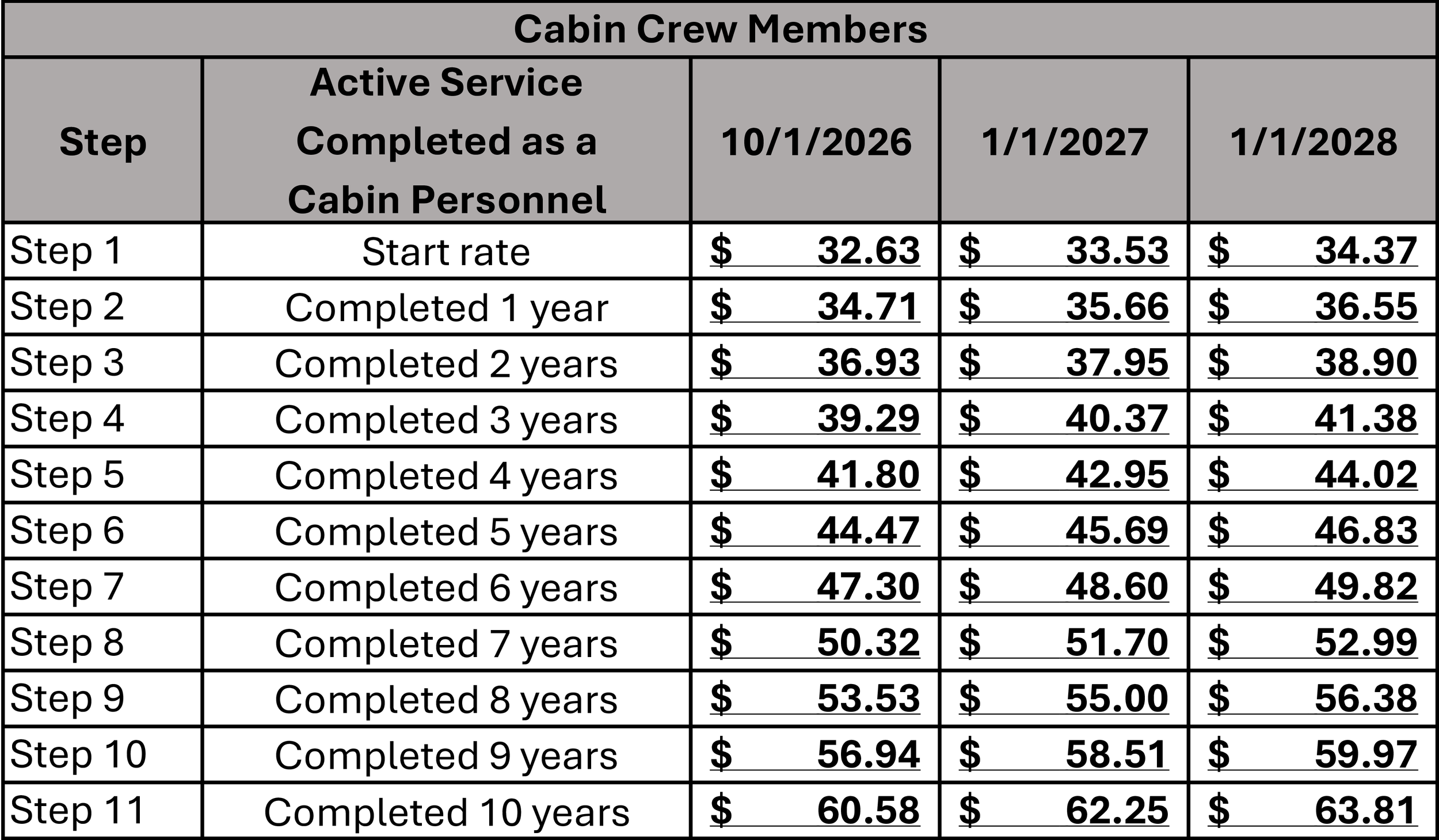
As an example, if you are currently on step 3 ($32.68) of the WestJet pay grid, you move to the proposed WestJet pay grid at step 3 ($36.93).
The Bargaining Committee believes that ratification is one of the most important decisions you will make during the collective bargainingprocess, and we want to ensure that you see the value in the gains we have achieved at the bargaining table. Your Bargaining Committee unanimously recommends and endorses this Tentative Agreement and urges all members to vote.
In unity,
Your WestJet Mainline Bargaining Committee
Bargaining Update #50: Tentative Agreement Release
Dear members,
In preparation for the upcoming ratification vote on the Tentative Agreement, your Bargaining Committee has two documents attached for members to review.
The first document was compiled by CUPE National. It brings together:
the Memorandum of Agreement (MOA); and
All matters that had already been settled and agreed to by the Parties before the date of the MOA, as referenced in Point 3 of the MOA.
These previously agreed matters are the tentative agreements reached and signed by the Parties during bargaining.
As this document brings all of the material together, it is lengthy and comprehensive. It includes both clean language and marked-up language, so members can see what was agreed to during the bargaining process. This format is a required part of the process.
How to read the marked-up language
When reviewing the document:
Bold language = new language that was agreed to
Struck-out language = language that was agreed to be removed and will not appear in the finalized Collective Agreement
Following ratification of the Tentative Agreement, the Parties (Company and Union) will work together to prepare the renewed Collective Agreement by incorporating all agreed-upon changes into the existing, unchanged language from CA1. Once compiled, members will be provided access to the complete, finalized Collective Agreement in electronic format.
The first document is necessarily technical and comprehensive because it contains the MOA together with the matters previously settled and agreed to by the Parties during bargaining. We recognize that its format and length may make it more difficult for members to navigate when reviewing the proposed changes.
Member Support Resource Document
To further support members in their review, Local 8125 Unit Vice-President (WestJet Mainline) and Bargaining Committee member Bryan Hansraj compiled a second, simplified document for reference purposes only.
This second version is intended to make it easier to follow the negotiated changes and compare the proposed language. It uses a similar format to help identify:
new and agreed-upon language; and
language agreed to be removed.
Important: This is reference material only to support our members.
Members must carefully review the disclaimer at the beginning of this document.
This second document is:
not an official bargaining document
not the Tentative Agreement
not the finalized Collective Agreement
It was prepared solely as a reference tool to assist members in navigating and understanding the negotiated changes.
While every effort was made to accurately reflect the agreed-upon language, this reference document must not be relied upon as an authoritative or official record of the agreement between the Parties.
Where there is any discrepancy, inconsistency, omission, formatting difference, or question regarding the agreed-upon terms, members must refer to the official documentation including the MOA and the matters settled and agreed to by the Parties referenced in Point 3 of the MOA.
Following ratification, the Parties will prepare the renewed Collective Agreement by incorporating the agreed-upon changes with the existing unchanged language from CA1. Once that process is complete, members will be provided access to the complete, finalized Collective Agreement in electronic format.
MATERIALS:
Members can view the Final Memorandum of Settlement - Prepared by CUPE scanned PDF version of the full Tentative Agreement articles here.
Members can view the simplified reference version created by the committee here.
Please note that this document is currently only available in English. Members wishing to reference the French versions of any of the agreed upon language can reference the Compiled Tentative Agreement – Prepared by CUPE document above.
VOTING:
Voting for ratification of the Tentative Agreement will open Monday, August 17, 2026 at 2:00pm MT and will run for seven (7) days, closing Monday, August 24, 2026 at 2:00pm MT.
Once you cast your vote, you will not be able to change or amend your vote.
Please take the time to exercise your right to vote on the Tentative Agreement. We unanimously recommend accepting this Tentative Agreement and trust that you see the monumental gains that we achieved during this round of negotiations.
IMPORTANT NOTE: While the format of these materials may appear complex, this is the standard process used to present newly negotiated language for ratification. Providing both the existing language and the proposed changes allows members to clearly see what was negotiated, what has changed, and what they are being asked to vote on. This approach supports a transparent and informed ratification process.
In unity,
Your WestJet Mainline Bargaining Committee
Bargaining Update #49: French Q&A
Dear members,
The translated version of the Question-and-Answer document has now been prepared. There has also been an update to the English document where a miscalculation was identified in an example being given.
The corrected value is highlighted in yellow in the English document and proactively corrected for the French.
Members may access their respective documents here.
In unity,
Your WestJet Mainline Bargaining Committee
Bargaining Update #48: Townhall Summary
Dear members,
This week, the Bargaining Committee focused on virtual townhall presentations where we delivered details of the Tentative Agreement that were agreed upon with this round of Collective Bargaining. We hosted over 1000 members across six town halls. This was fantastic and provided our Committee with the opportunity to not only provide insight into the achievements that we were able secure for our members, but also to provide a candid overview of where the Committee and member goals were not achieved to their fullest extent.
The ability to explain the 'why' behind how things resulted in the way that they did is an important step in the ratification process.
Members who were unable to attend, or those who wish to see the presentation again, can view a recording of the official presentation here.
The Bargaining Committee has also consolidated over 800 questions that were submitted by members surrounding the content of the Tentative Agreement. Members can access that document here.
Once we have finalized the document that contains all formal language changes related to the Tentative Agreement in both English and French, it will be circulated to the membership and the electronic ratification voting process will be opened and will run for seven (7) days.
Your Bargaining Committee unanimously recommends member acceptance of the Tentative Agreement as reached between the parties, and we urge all members to exercise their right to vote.
In unity,
Your WestJet Mainline Bargaining Committee
Bargaining Update #47: Wage Increase Breakdown
Dear members,
We have completed the 6 townhall presentations. Well over 1000 members in total were able to attend from across our network, and the Bargaining Committee was pleased to share the how and the why behind the tentative agreement we're bringing to the members for ratification.
We're committed to preparing a response to the questions submitted through the online platform prior to voting opening for ratification of the tentative agreement.
One specific theme appeared at all townhalls and the committee would like to address all members in a timely fashion. This central concern centered around the across-the-board wage increases members will receive, and the differences between WestJet Cabin Personnel and those members who joined from Sunwing.
WestJet Mainline Cabin Personnel (excluding former Sunwing members)
Under the terms of the tentative agreement, WestJet Mainline Cabin Personnel will receive a 13% across all steps of the WestJet pay grid. This applies to all members regardless of how they reached their applicable pay step. Any former Encore or Swoop members who have flowed, or anyone integrated from Swoop are on existing WestJet pay steps and will see their respective pay steps increase by 13%.
As an example, if you currently are at step 3 ($32.68) of the WestJet pay grid, you move to the proposed WestJet pay grid at step 3 ($39.29).
Retroactive payments will be made to any Cabin Personnel who were active from January 1, 2026 to September 30, 2026 based on the number of credit hours worked in that time frame. Members who received a step increase between January 1 and September 30 of 2026 will see their retroactive pay reflect 13% of your applicable rates of pay during that time period.
WestJet Savings Plan contributions over the same time period will also receive a retroactive 13% payment issued. This will be issued as part of the retroactive payments and not deposited into your WestJet Savings Plan account.
Former Sunwing Cabin Crew (and former Cabin Safety Managers)
Under the terms of the tentative agreement, all former Sunwing members will also receive a 13% retroactive payment based on all credit hours worked from January 1 to September 30, 2026. This payment will be based on their current frozen wage at the time of the merger.
Any mapping to the WestJet pay grid, or choices made by those former Cabin Safety Managers who can chose to be mapped or not, will take place after the calculations being considered for retroactive payments.
A more fulsome communication will be released after the final townhall outlining our next steps. Also to come is a comprehensive response document to the questions submitted using the online forum, prior to the vote for ratification of the tentative agreement.
Ratification continues to be one of the most important decisions you will make during the collective bargaining process, and we want to ensure that you see the value in the gains we have achieved at the bargaining table. Your Bargaining Committee unanimously recommends and endorses this Tentative Agreement and urges all members to vote.
In unity,
Your WestJet Mainline Bargaining Committee
Bargaining Update #46: Duty Period Premium Explained
Dear members,
It has been three years since the Airline Division of CUPE launched the Unpaid Work Won’t Fly Campaign and most recently our Local’s own campaign on the matter. It is no secret the amount of the unpaid work we experience as Cabin Personnel – whether it is our pre-flight checks, boardings, delays, sits between flights – the list goes on.
The Tentative Agreement that your Bargaining Committee has achieved includes a breakthrough framework for compensation of our unpaid work and time at the company. This framework will only grow into out next Collective Agreement which is only a little over two years away.
The Bargaining Committee believes that ratification is one of the most important decisions you will make during the collective bargaining process. We want to ensure that you see the value in the gains we have achieved at the bargaining table. Your Bargaining Committee unanimously recommends and endorses this Tentative Agreement and urges all members to vote.
One of the most significant gains achieved in this Tentative Agreement is the introduction of the Duty Period Premium (DPP), a new framework that recognizes time worked beyond the credit hours paid on a pairing.
The implementation of DPP will occur in two phases:
Phase 1
Beginning with the first full monthly scheduling period following ratification, members will receive a monthly Duty Period Premium Payment based on the number of flight legs operated, along with additional credit for eligible ground delays.
Phase 2
Beginning March 2, 2027, the full Duty Period Premium language will take effect. DPP will be calculated by comparing your total monthly duty time against monthly credit hours. In simple terms, the more your duty time exceeds your credited time over the course of a month, the greater your DPP payment may be.
The Bargaining Committee believes this represents an important step toward recognizing work that has historically gone uncompensated and establishes a new framework that values time spent on duty, not solely time spent flying.
To help members understand how DPP works, we have prepared:
Visit wjcomponent.ca/ta-info to review these resources and learn more.
Don't forget to register for an upcoming Town Hall here and cast your ballot when voting opens.
In unity,
Your WestJet Mainline Bargaining
Bargaining Update #45: Expanded Summary - French
Dear members,
This brief note is to inform you that the Expanded Review of Negotiated Improvements document has now been prepared in French.
Members can access this document here, and it will be uploaded to the wjcomponent.ca website in the near future.
In unity,
Your WestJet Mainline Bargaining Committee
Bargaining Update #44: Question Submission Form
Dear members,
We have created a form for members to submit questions to the Bargaining Committee. This form is for both leading up to the first virtual session on Tuesday, August 11, and afterwards should further questions arise.
Members are encouraged to submit multiple forms if they have more than one question.
Ratification is one of the most important decisions you will make during the collective bargainingprocess, and we want to ensure that our members have the opportunity to ask questions and seek clarity.
Please visit here to submit your questions.
In unity,
Your WestJet Mainline Bargaining Committee
Bargaining Update #43: TA Townhall Signup
Tentative Agreement Townhall: Your Agreement. Your Questions. Your Vote.
Dear Members,
Your Bargaining Committee would encourage you to attend one of our Tentative Agreement Townhalls.
These sessions are designed to help members understand the Tentative Agreement before voting. Our goal is to walk through the changes, explain how they work, answer your questions, and ensure every member has the information they need to make an informed decision.
Each session will include a review of the bargaining process, all changes that were made during the negotiations process along with a question and answer period.
An overview of the Tentative Agreement
Wage increases and compensation changes
Scheduling and work rule improvements
Benefits and retirement enhancements
Sunwing pay-step mapping
Ratification process and voting information
Live Question & Answer period
All sessions will cover the same content, so members only need to attend one.
Townhall Schedule (please refer to your personal email for the signup link)
| Day | Time |
|---|---|
| Tuesday, Aug 11 |
11:30 – 14:30 MT 13:30 – 16:30 ET |
| Tuesday, Aug 11 |
17:30 – 20:30 MT 19:30 – 22:30 ET |
| Wednesday, Aug 12 |
10:00 – 13:00 MT 12:00 – 15:00 ET |
| Wednesday, Aug 12 |
16:00 – 19:00 MT 18:00 – 21:00 ET |
| Thursday, Aug 13 |
12:30 – 15:30 MT 14:30 – 17:30 ET |
| Friday, Aug 14 |
08:30 – 11:30 MT 10:30 – 13:30 ET |
What to Expect
These sessions are intended to provide a detailed explanation of the Tentative Agreement and give members an opportunity to ask questions directly to the Bargaining Committee. The full language will not be available at these town halls as the CA is currently being compiled, reviewed, translated and will be available prior to voting opening.
The Tentative Agreement contains a number of technical provisions, including a new pay trigger system and the Sunwing pay-step mapping. Given the complexity of these changes, we strongly encourage members to attend a ratification session to fully understand how the provisions apply before casting their vote.
Registration
On the day of the meeting, members are encouraged to log in 15–20 minutes prior to the scheduled start of the meeting to allow sufficient time for entry and verification.
To be granted entry into the meeting, you must change your name to reflect your Employee Number and First and Last Name as listed on the seniority list. If you cannot be verified, entrance to the meeting will not be granted.
Example:
Joe Smith 87654
We encourage all WestJet Mainline members to attend.
In unity,
Your WestJet Mainline Bargaining Committee
Bargaining Update #42: Expanded TA Improvements
Dear members,
The Bargaining Committee has prepared a high-level summary document that outlines changes negotiated through the bargaining process, broken down by each article. We've also included a summary of the various Letters of Understanding (LOUs) negotiated that outline other agreements that have been reached between the parties during the bargaining process.
This is intended to frame the conversations and member questions that will be addressed by the Bargaining Committee during the upcoming town hall meetings. A separate communication will be released in the near future, which will outline the townhall schedule and links for member registration.
The Bargaining Committee believes that ratification is one of the most important decisions you will make during the collective bargaining process, and we want to ensure that you see the value in the gains we have achieved at the bargaining table. Your Bargaining Committee unanimously recommends and endorses this Tentative Agreement and urges all members to vote.
To view the high-level summary, please click here.
Stay tuned for information surrounding the townhall timelines and registration links.
In unity,
Your WestJet Mainline Bargaining Committee
Bargaining Update #41: Further Updates
Dear members,
The Bargaining Committee continues to prepare information for the upcoming roadshows, as well as a comprehensive list of all changes made throughout the agreement to frame the questions and answers leading to the eventual vote.
While that work continues, we are also building a document that outlines the Memorandum of Agreement (Tentative Agreement) as well as all of the language that has been agreed upon between the parties. That document will be circulated to you with your voting link after the conclusion of all roadshows when voting is opened.
In addition to the high-level summary provided yesterday, and in an effort to support member ratification of the tentative agreement, the Bargaining Committee will provide additional information on a couple of topics that have been the subject of member queries.
Ratification, as previously stated, is one of the most important decisions you will make during the collective bargaining process, and we want to ensure that you see the value in the gains we have achieved at the bargaining table. Your Bargaining Committee unanimously recommends and endorses this Tentative Agreement and urges all members to vote.
Reduced Block Programs
Reduced Block (Permanent)
Reduced the scheduling window to 50–70 credit hours (50 Credit Hour MMG)
Can be flexed up to 90 credit hours 6 months a year
Can be bid out of with through the vacancy bid process found in Article 24 – Filling Of Vacancies
Temporary Reduced Block
Identical blocking windows as the permanent reduced block outlined above
Will be awarded in up to 3 consecutive monthly scheduling periods
Temporary Zero Block
Cabin Personnel in the temporary zero block program shall not pick up any Company open time or Shift Trades
Will be awarded to each Cabin Personnel for no more than 2 monthly scheduling periods
Temporary Mini-Block programs
All parameters such as the scheduling window, minimum Days Off, duration and MMG shall be determined by the Company and communicated at the time of offer.
NOTE: All awards of any of the flexible bidding options outlined above are subject to availability by the company and will be awarded by seniority and a basis of base and classification.
Ad Hoc Assignments
Ad hoc assignments will include the following additional compensation:
Training: $75
Quality Assurance: $50
Peer Support or Recruitment: $50
Other assignments: As determined by the Company, to a maximum of $100
Note: These amounts apply to non-pairing activities and are paid per day, in addition to the applicable standard credit hours for that day.
(LOU) No. X – Uniform Identification and Small Roller Bag
This LOU ensures the next uniform design will have a distinct piece made available only to Cabin Personnel
It also, subject to successful wear testing, includes a commitment to replace the existing satchel with a new small roller bag beginning in 2027.
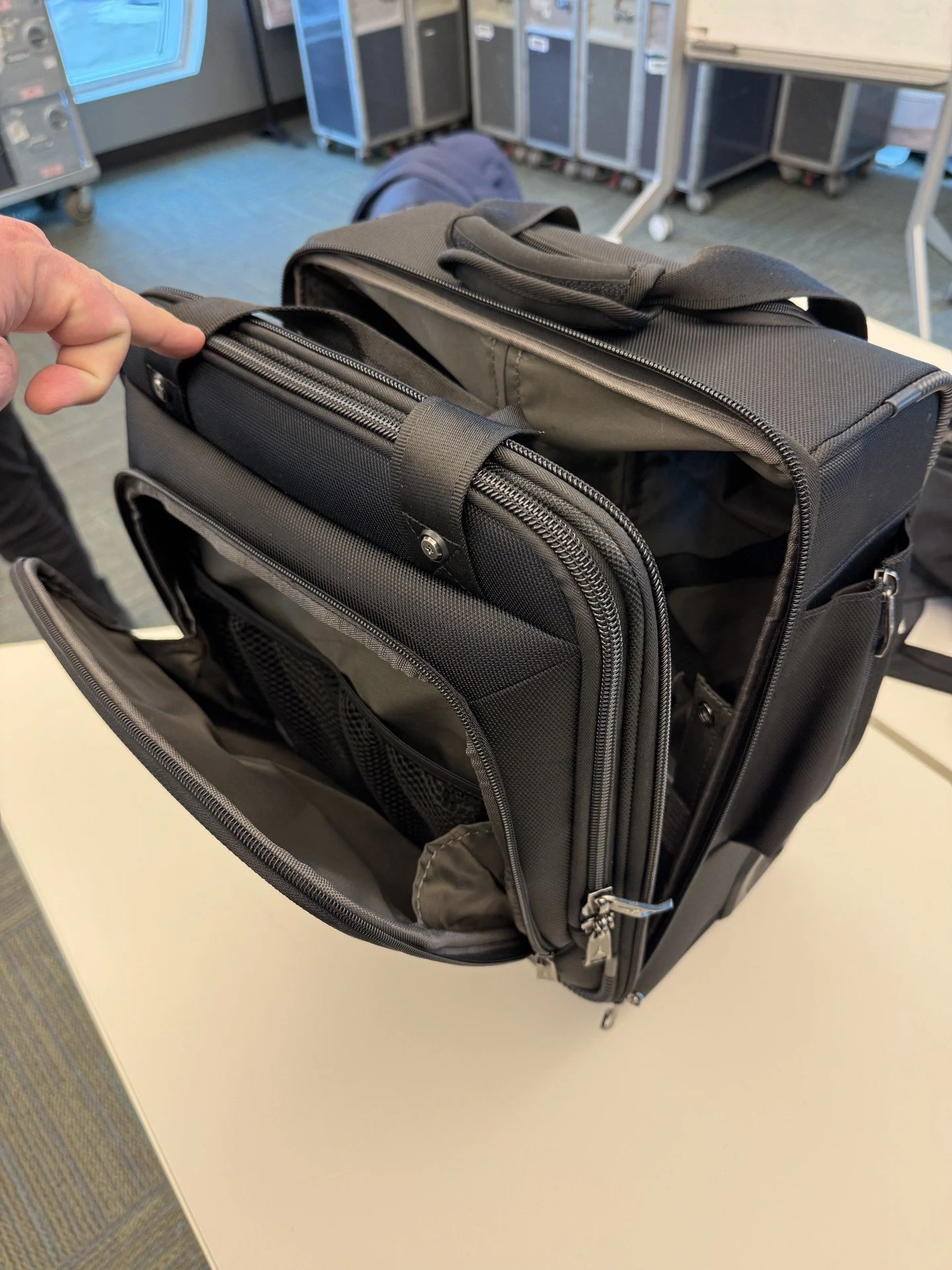
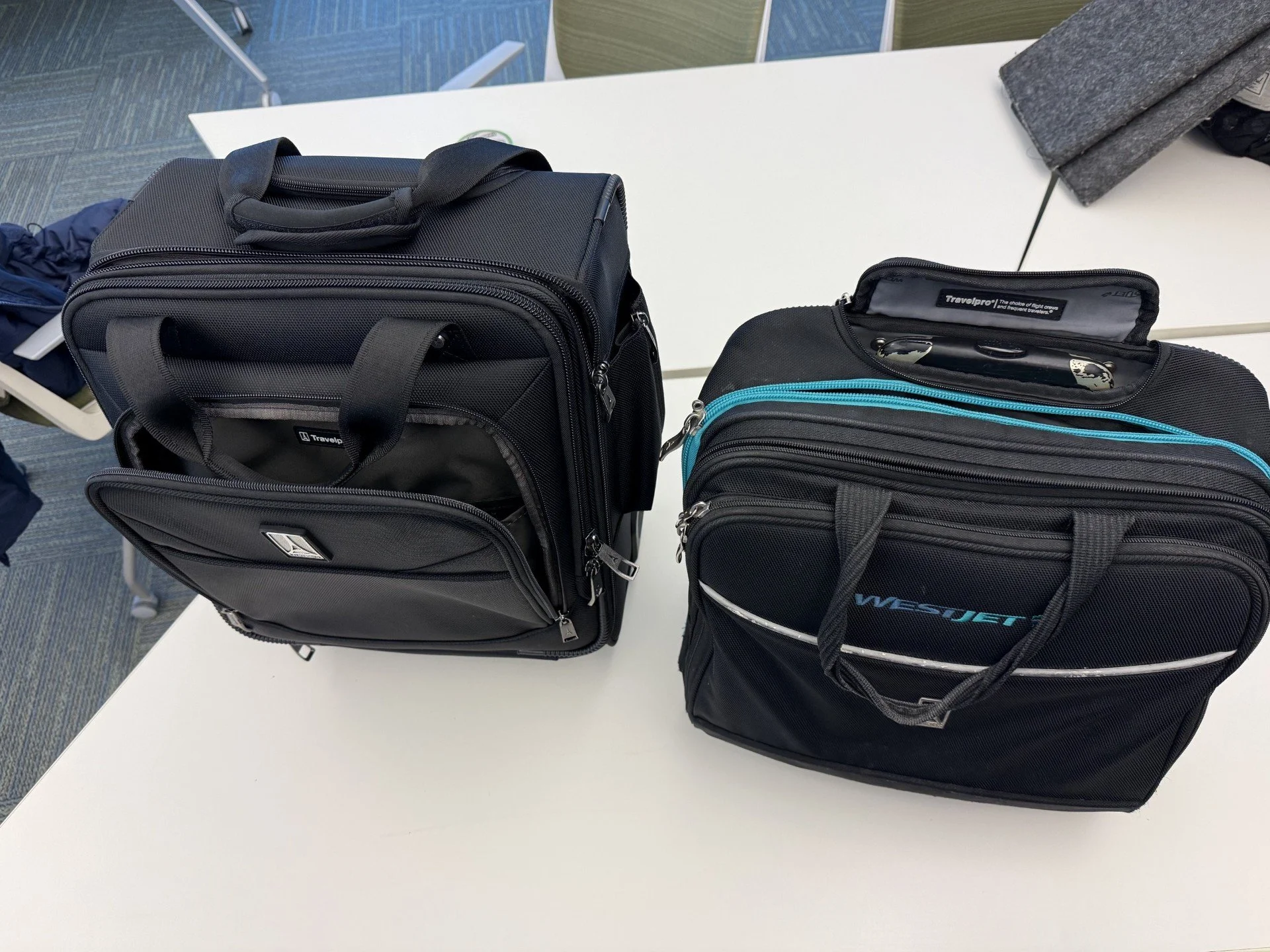
We look forward to sharing further details and the full compressive list of changes in the coming days. Members are also encouraged to continue to check their emails and social media for registration in the upcoming townhalls.
In Unity,
Your WestJet Mainline Bargaining Committee
Bargaining Update #40: Understanding Sunwing Mapping
Dear Members,
We have prepared the following reference document to transparently communicate the Sunwing mapping negotiated for our Tentative Agreement. The full language will be made available once our agreement is compiled.
Sunwing Pay-Step Mapping
The Sunwing pay-step mapping is one of the more technical parts of the tentative agreement because it replaces the CIRB wage-integration language with a process that moves former Sunwing employees onto the WestJet Collective Agreement pay grid.
A member's final placement depends on two main factors:
their cumulative active service at Sunwing and WestJet; and
their applicable Sunwing hourly rate as of September 30, 2026.
What remains consistent
The proposed agreement uses the same service bands that existed in the former Sunwing Flight Attendant wage grid, beginning at 0–6 months and continuing through 120+ months.
It also requires cumulative active service to be calculated in accordance with Sunwing Collective Agreement No. 3.
Service at Sunwing - is carried forward, with former Sunwing employees being mapped onto the new WestJet pay grid.
How the mapping works:
Step 1: Service-based placement on the WestJet pay grid
Former Sunwing employees are first assigned a WestJet pay step based on their total cumulative active service at Sunwing and WestJet:
| Active service | Initial WestJet step |
|---|---|
| Less than 12 months | Step 1 |
| 12+ months | Step 2 |
| 24+ months | Step 3 |
| 36+ months | Step 4 |
| 48+ months | Step 5 |
| 60+ months | Step 6 |
| 72+ months | Step 7 |
| 84+ months | Step 8 |
| 96+ months | Step 9 |
| 108+ months | Step 10 |
| 120+ months | Step 11 |
Step 2: Wage-protection comparison
Each member hourly rate at the service-based initial WestJet step is then compared with the member applicable Sunwing rate as of September 30, 2026.
If the member hourly rate on the WestJet Collective Agreement pay grid is higher than the member applicable Sunwing rate as of September 30, 2026, the member remains on their initial WestJet pay step as determined above.
If the member hourly rate on the WestJet Collective Agreement pay grid is equal to or lower than the member Sunwing rate, the member moves to the closest WestJet step that is higher than the member's current Sunwing rate.
This means two employees with the same active service may receive different final steps if their applicable Sunwing rates are different.
Flight Attendants and Cabin Safety Managers
Under the former Sunwing agreement, Cabin Crew Members included both Flight Attendants and Cabin Safety Managers. CSM was a separate classification with its own pay structure and progression.
The proposed mapping does not recreate the Sunwing CSM classification at WestJet.
However, if a former CSM had a higher applicable Sunwing hourly rate, that rate is used in the same wage-protection comparison described above. This may result in a higher final WestJet pay step.
This is a wage-protection outcome. It does not provide additional seniority, change the Master Seniority List or continue CSM status at WestJet.
Employees whose current pay rate is above the WestJet Collective Agreement pay grid
If a member’s applicable Sunwing rate is higher than the WestJet Collective Agreement Step 11 rate, they receive a one-time choice:
move to Step 11 of the WestJet Collective Agreement pay grid and become eligible for the WestJet Savings Plan (with up to 20% Employer contribution) and rotational lead-duty payment of 3.125%; or
remain temporarily under the applicable Integration Transition Document compensation provisions (i.e. remain at their current Sunwing rate of pay with current Sunwing RRSP provisions). Employees who choose this option will receive their applicable rate of pay until Step 11 of the WestJet Collective Agreement pay grid exceeds their applicable rate of pay or until the expiry of this Collective Agreement.
What happens after mapping
Once mapped to the WestJet CA2 pay grid, employees begin progressing under the WestJet collective agreement.
Employees placed above their service-based step through the wage-protection rule are deemed to have the active service needed to hold that pay step for future pay progression only. This does not give them additional seniority.
For a comprehensive question and answer document, please click here.
In Unity,
Your WestJet Mainline Bargaining Committee
Bargaining Update #39: Highlights of the Tentative Agreement
Dear Members,
The Tentative Agreement contains substantial improvements across the Collective Agreement. The highlights below are intended to provide an overview of the key changes and are not an exhaustive summary of everything that was negotiated.
More detailed information and the complete Tentative Agreement language will be released in the coming days and discussed during our town halls to ensure every member has the information needed to make an informed decision.
Ratification is one of the most important decisions members make during collective bargaining. Your Bargaining Committee unanimously recommends this Tentative Agreement and encourages every member to vote.
Term:
We have negotiated a 3-year tentative agreementthat would be in effect from January 1, 2026, to December 31, 2028.
NEW Duty Period Premium
This tentative agreement expands how Flight Attendants are compensated by introducing a new Duty Period Premium for required duty hours that are not captured through the flight credit system. Together with the negotiated credit-hour wage increases, this creates a second source of compensation growth by recognizing and paying for previously non-credited duty hours.
Bridging formula beginning the first full monthly scheduling period following ratification based on the cumulative number of legs (at 1 hour) a Cabin Personnel works in a month, calculated based on the same formula as the process outlined immediately below.
| Period | Percentage Paid |
|---|---|
| March 2, 2027 to December 31, 2027 | 75% |
| January 1, 2028 to December 30, 2028 | 85% |
| December 31, 2028 onward | 100% |
Earnings are eligible for WestJet Savings Plan contributions.
Equivalent to an additional (approx.) 12% of salary increase
Note: This is variable based on the number of non-credited hours that would now be captured with the Duty Period Premium.
Note: Unlike traditional RIG provisions found in many collective agreements, this is not subject to reconciliation. It is a standalone payment that is paid in addition to all other earnings, ensuring its value is not reduced or offset through the reconciliation process.
Wage Calculator
We have created a wage calculator tool on our website for members to look at examples and put their own pairings in to understand the additional compensation that will be received.
CLICK HERE TO VIEW THE NEW DUTY PERIOD PREMIUM CALCULATOR
Credit Hour Wage Increases
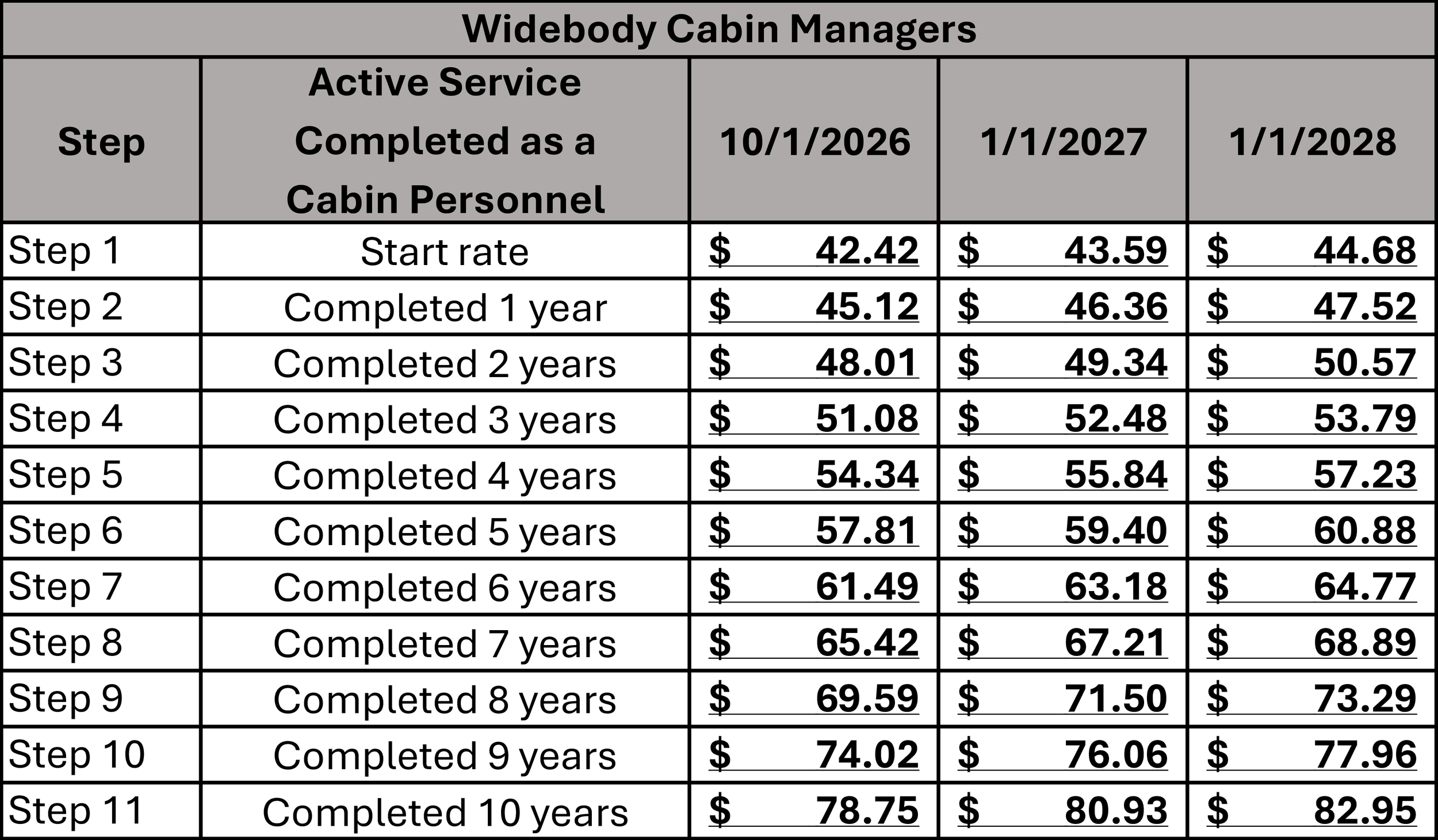
13% Across-the-Board Increase effective October 1, 2026
Additional 2.75% increase on January 1, 2027
Additional 2.5% increase on January 1, 2028
Members will receive 13% retroactive pay on all credit hours earned between January 1 and September 30, 2026, as well as retroactive pay that matches contributions to the WSP.
In comparison, Air Canada's first year wage increases were not across the board and varied depending on what step of the scale their members were at.
Cabin Personnel Hourly Rates of Pay
Widebody Cabin Manager Rates of Pay
Per Diem Increases
| Location | Implementation | 2027 | 2028 |
|---|---|---|---|
| Standard | $4.62 | $4.75 | $4.87 |
| North America (except Canada) | $6.00 | $6.17 | $6.32 |
| Intercontinental | $6.94 | $7.13 | $7.31 |
| UK / Ireland / Japan / Iceland | $7.62 | $7.83 | $8.03 |
WSP Program protection
For the first time, the Collective Agreement guarantees access to the WestJet Savings Plan (WSP). Rather than relying on a Company program that could be changed or withdrawn, members now have contractual protection for the duration of the agreement.
Sunwing Pay Mapping
Fair and transparent processes have been outlined for wages of former Sunwing Cabin Crew and Cabin Safety Managers moving forward.
Scheduling Improvements
Maximum flight segments at planning are reduced from 5 to 4.
Maximum planned duty period for 3+ segment days reduced from 14 hours to 13 hours.
Duty period extension requiring consent reduced from 16 hours to 15.5 hours.
New maximum duty day penalty of $600 when a duty period exceeds the maximum by 91 minutes, while keeping other penalties intact.
Minimum rest at base increased from 12 to 13 hours. Minimum planned rest away from base increased from 10.5 hours to 11.
Stronger protections during IROPs using lobby-to-lobby rest calculations (increased from 9 hours to 10).
New 0.5x reassignment premium (on additional credit hours) if reassigned with a base, with certain exceptions.
Stronger protections around stand-up duty periods (including it being counted as two duty periods)
Introduction of flexible scheduling options including a reduced block program.
Out of base partial shift trades.
Reserve Improvements
Three biddable reserve windows, each 11 hours in length.
Reserve rest parameters are aligned with scheduled rest parameters.
Elimination of RFX.
Better seniority protections.
Improved reserve transparency, including the ability to view Cabin Personnel holding RTD reserve.
Per diems for Airport Standby Reserve.
Credit protection for reserve assignments.
Vacation, GDOs, and Special Days Off Improvements
Three Guaranteed Days Off (GDOs) for every vacation week.
Introduction of a 5th week of vacation at 25 years of service.
Up to three Special Days Off each year for major life events.
Removal of Post-Flight Aircraft Tidying
Aircraft tidying duties are eliminated within 6 months of ratification, limited exception during limited IROP situations in destinations where grooming is unavailable.
Hotel & Layover Protections
Compensation when hotel rooms are not ready.
Stronger hotel selection language.
Better protections during IROPs.
Increased hotel liability protections.
Protection against losing hotel rooms before reporting.
Improved Sick Leave
Full-time sick bank increases from 22 to 24 days.
Arbitration for the Attendance Management Support Program (AMSP) is scheduled for April 2027.
Uniform & Equipment Improvements
$100 annual shoe allowance.
Increased allotment for initial uniform pieces.
Uniform replacement allowance increases to $375/year.
Lost luggage reimbursement increases from $750 to $2,300.
New roller bag commitment.
Union lanyards permitted.
Seniority
Clarification that MSL date will be based on a Cabin Personnel’s most recent completion of initial training after quitting and rehiring.
Secured a binding Letter of Understanding to complete the Swoop and Encore Flow seniority integration immediately following ratification of this Tentative Agreement, with the final seniority list to be presented to the membership for its own ratification vote.
Health and Safety, Workplace Protections and Benefits
Workplace violence language added to the Collective Agreement.
Enhanced pregnancy and breastfeeding accommodations including a new maternity top up program.
Better health and safety protections.
Removal of the 9-month probation period, reduced to 6 months.
Additional $300 annually towards the Health Spending Account
Voluntary Separation Packages
The Company shall have the option of offering up to five hundred (500) Voluntary Separation Packages to Cabin Personnel who have completed at least seventy-two (72) months of continuous employment with the Company.
Further details will be released either at the roadshows or with the publishing of the full tentative agreement.
In Unity,
Your WestJet Mainline Bargaining Committee
Bargaining Update #38: Understanding the Ratification Process
Dear Members,
Your Bargaining Committee has prepared a high-level overview of the key changes contained in the Tentative Agreement. This overview is intended to introduce the major improvements and changes that were negotiated during collective bargaining.
The overview is not a replacement for the complete Tentative Agreement.
CUPE National is assisting with the preparation and final review of the legal contract, which will be provided to members in advance of the ratification vote. Members will also receive additional explanatory materials, implementation information, and opportunities to ask questions before voting begins.
This document explains what to expect over the coming weeks, the ratification process, and what happens depending on the outcome of the vote.
This communication will be released in the coming hours.
Our Commitment to Members
Your Bargaining Committee is committed to ensuring every member has the information they need to make an informed decision.
We understand that members have different priorities, experiences, and expectations. While not every negotiated outcome will affect every member in the same way, every member deserves clear, honest, and transparent information about what was achieved, where things evolved landing us to this final state.
Throughout the ratification process, we will host town halls, answer questions, and provide additional context.
If you have questions, ask them.
We would rather answer the same question many times than have members rely on assumptions, rumours, or incomplete information. Our role is to help members understand the agreement, not simply present it.
Your Vote, Your Right, and Your Responsibility
Every member has the democratic right to vote Yes or No on the Tentative Agreement. That right belongs to every individual member and will always be respected.
With that right comes the responsibility to make an informed decision.
We encourage every member to:
review the Tentative Agreement and supporting materials;
attend a ratification townhall if possible;
ask questions if something is unclear;
consider the agreement as a complete package; and
understand the consequences of both accepting or rejecting the agreement.
Collective bargaining is a process of negotiation. It is a process of push and pull, not simply one side making demands until every proposal is achieved. Every collective agreement reflects priorities, compromise, and movement by both parties.
Even during a strike or other job action, there is no guarantee that every bargaining objective will ultimately be achieved. The question before members is whether the negotiated agreement represents an acceptable outcome, when compared to the realistic alternatives available.
Our responsibility is not to tell members how to vote. Our responsibility is to ensure members understand the agreement, the bargaining process, and the consequences of each possible outcome. Once members have that information, the decision belongs to them.
Information, Social Media and Artificial Intelligence
During the ratification process, members will see information and opinions from many different sources, including social media, group chats, artificial intelligence (AI) tools, and conversations with coworkers.
These discussions are a normal part of the process, but they are not always complete or accurate.
AI tools can misunderstand contract language, overlook important context, or confidently provide incorrect interpretations. Similarly, social media discussions often reflect individual opinions rather than the complete bargaining picture.
We encourage members to use the official Tentative Agreement, Bargaining Committee communications, FAQs, and ratification townhalls as their primary sources of information.
If something you read online raises a question, ask us. We are committed to answering questions and helping members understand the agreement.
Ultimately, every member is responsible for their own vote. Make your decision based on verified information, a review of the complete agreement, and your own assessment—not on rumours, speculation, or pressure from others.
What Happens Next?
Ratification Townhalls
Your Bargaining Committee will host a series of ratification townhalls next week to review the Tentative Agreement, explain the bargaining process, discuss the major negotiated changes, and provide the context behind the Committee's recommendations.
These sessions are intended to help members understand the agreement before voting and will include opportunities to ask questions and receive clarification.
Dates, registration information, and additional details will be shared shortly.
Ratification Vote
Following the townhalls, members will have the opportunity to vote on the Tentative Agreement. Members will vote on the agreement as a complete package.
If the Tentative Agreement Is Ratified (YES VOTE)
If members vote YES to ratify the Tentative Agreement, implementation will begin according to an agreed-upon implementation schedule.
Some improvements will take effect immediately, while others may require payroll updates, scheduling changes, system modifications, or implementation at the beginning of a future bid period.
Members will receive a detailed implementation timeline outlining when various provisions are expected to come into effect.
If the Tentative Agreement Is Rejected (NO VOTE)
If members vote No, the parties will return to mediation for up to 30 days in an effort to reach a revised agreement.
If mediation is unsuccessful, the remaining outstanding issues will proceed to binding arbitration.
It is important to know that arbitration is not another round of bargaining.
An arbitrator does not simply take the Tentative Agreement and add the items members wanted. Arbitration is a separate legal process in which the arbitrator considers the evidence presented by both parties, industry comparators, applicable labour relations principles, and what they determine to be a reasonable outcome.
Arbitration does not guarantee a better agreement.
The outcome could be better in some areas, worse in others, or substantially similar to the Tentative Agreement.
Some members may consider voting No because a particular proposal was not achieved. That is every member's right. However, members should also consider whether that issue is one an arbitrator is likely to award, and whether pursuing that objective could place other negotiated gains at risk. Ask questions in the townhalls.
Not every improvement achieved through collective bargaining is automatically preserved or enhanced in arbitration. Bargaining allows parties to negotiate creative solutions, compromises, and package settlements that may not be available through an arbitrated award.
During the townhalls your Bargaining Committee can provide additional information about the arbitration process, including realistic expectations regarding issues members may be considering when deciding how to vote. Our goal is not to persuade members to vote one way or the other, but to ensure everyone understands both the opportunities and the risks before making their decision.
Moving Forward Together
Ratification is one of the most important decisions members make during collective bargaining.
Your Bargaining Committee encourages every member to take the time to review the materials provided, participate in the townhalls, ask questions, and make an informed decision based on the complete agreement and a clear understanding of what comes next.
Whatever your decision, we ask that it be based on facts, informed discussion, and an understanding of the bargaining process.
We look forward to continuing these conversations with you throughout the ratification process and thank every member for their engagement, professionalism, and participation.
In Unity,
Your WestJet Mainline Bargaining Committee
Bargaining Update #37: Next Steps
Dear Members,
Early this morning around 4:15am MT, your Bargaining Committee reached a tentative collective agreement with WestJet.
After a quick nap we fulfilled our media commitments and have now turned our full attention to planning the ratification process.
We will begin releasing information about the tentative agreement, along with the schedule for ratification town halls. We recognize that schedules have now been published and that coordinating hotels, flights, venues, and the Bargaining Committee's travel may present some logistical challenges. Despite that, we are moving forward as quickly as possible to ensure every member can receive the information and have the opportunity to ask questions.
Finally, we thank you. Our membership’s support and unity carried us through this round of bargaining, and we are incredibly grateful for the trust you placed in us.
Standby for further instructions.
In Unity,
WestJet Mainline Bargaining Committee
Tentative Agreement Reached - Strike is Over
Dear members,
After months of negotiations and countless hours at the bargaining table, the Bargaining Committee has been working tirelessly to achieve a fair collective agreement for our membership.
As of 4:15am on August 3, we are advising that your Bargaining Committee and the Company have reached a tentative agreement.
This means that the strike is officially over. All picketing activities must cease effective immediately.
We know members are eager to learn the details of the negotiated agreement. The Bargaining Committee is currently preparing a comprehensive bargaining update and will be providing the membership with preliminary details of the tentative agreement in the coming day(s).
The Bargaining Committee will also announce a series of ratification town halls, where members will have the opportunity to review the details of the negotiated tentative agreement, hear directly from the Bargaining Committee, and ask questions about the proposed language and changes. Additional information regarding the dates, times, and format of these town halls will be shared as soon as it is available.
Following the ratification town halls, the membership will have the opportunity to cast their vote on whether to accept the tentative agreement.
In the meantime, we expect the Company to begin ramping up operations. We have signed a ramp up agreement with the Company that can be viewed by clicking the link below.
CLICK HERE TO VIEW THE RAMP UP AGREEMENT
Members who were previously on pairings will likely be returned to duty and coded RTD (Return to Duty) by the Company. Members on reserve should ensure they are available for activations from Crew Scheduling in accordance with the provisions of the expired Collective Agreement.
Until further communication is issued by the Union, members should continue to monitor their email and official Union communication channels for updates. Members are still encouraged to wear their union pins and lanyards during this time.
We want to sincerely thank every member for your solidarity, professionalism, and unwavering support throughout this process. Your unity, patience, and resolve have been instrumental in reaching this tentative agreement. While there is still an important ratification process ahead, today's milestone would not have been possible without the strength and commitment of our membership.
In Unity,
Your WestJet Mainline Bargaining Committee
Bargaining Update 36: Negotiations Continue - Stay United
Dear Members,
Today marks a historic moment as WestJet Mainline Flight Attendants stand together in the first lawful strike in our group's history. The unity demonstrated by our membership sends a clear message: our goal has always been to achieve a fair collective agreement that recognizes the value of the work Cabin Crew perform every day.
Following the Company's communication on details from the bargaining room, we believe it is important to provide members with additional context. The Company has suggested that the remaining issues are largely resolved. We do not share that view.
Their proposal represents movement and, for the first time, acknowledges that work performed outside of flight time deserves compensation, a reality Cabin Crew have always known.
We welcome that recognition.
We have seen this before. The current flight credit system was introduced with the promise of fairly compensating Cabin Crew. Over time, that promise eroded, leaving members routinely performing required work without being fully compensated.
This proposal moves the conversation forward, but it still places too little value on that work and only compensates for it in limited circumstances. That is why we cannot responsibly replace one system with another, unless we are confident it will deliver fair and lasting recognition for all required work.
Our position remains simple: when Cabin Crew are required to work, that work should be fairly recognized and fairly compensated. The Company has made meaningful progress. We are asking them to take the final step and deliver a solution that resolves the problem for the long term.
IN SUMMARY
Collective agreements are built to last. The systems we negotiate today will govern our profession for years to come. Our responsibility is not to secure language that appears to address the issue on paper, but language that provides a stable, durable foundation that fairly recognizes work whenever it is performed.
We remain deeply disappointed that the Company has chosen to park aircraft rather than reach an agreement that fairly compensates its valued Cabin Crew.
Parking aircraft and cancelling flights are decisions made by the Company. They are not an inevitable consequence of this dispute. Throughout this process, our Bargaining Committee has remained at the table, ready and willing to negotiate a fair collective agreement.
That distinction matters.
This dispute has never been about creating disruption. It has always been about correcting a longstanding compensation model that requires Cabin Crew to perform significant amounts of unpaid work. Labour peace can be restored at any time through meaningful bargaining that addresses the underlying issue rather than managing its symptoms.
Stand by for further instructions.
In unity,
Your WestJet Mainline Bargaining Committee
We are on STRIKE
Dear members,
As of August 2, 2026 at 00:00 MT, we have been unable to reach a tentative agreement with WestJet. As a result, WestJet Mainline members are officially on strike.
From this moment forward, all members are expected to follow the Union's strike directives.
Official website with more information: wjcomponent.ca/jobaction
Members Away From Base
If you are currently away from your base mid-pairing, you will follow the provisions outlined in the Operational Wind Down Agreement.
Members away from base mid-pairing must also complete the following forms:
Members Not Currently Working
If you are not on a pairing, you are expected to sign up for a picket shift. Picket lines are commencing at all permanent bases and select domiciles. Locations, schedules, and sign-up information are available on our website.
Sign up for your picket shift here: wjcomponent.ca/picketing
Communication with the Company
During an active strike, you are not required to answer or engage with Company representatives or Crew Scheduling, except where communication is required under the Operational Wind Down Agreement.
Strike Status
Our strike remains in effect until you receive explicit communication from your Union that the strike has ended. Do not rely on media reports, social media, or Company communications regarding the status of the strike.
Thank you for your solidarity, professionalism, and commitment as we stand together in support of achieving a fair collective agreement.
Standby for further instructions.
In Unity,
Your WestJet Mainline Bargaining Committee